

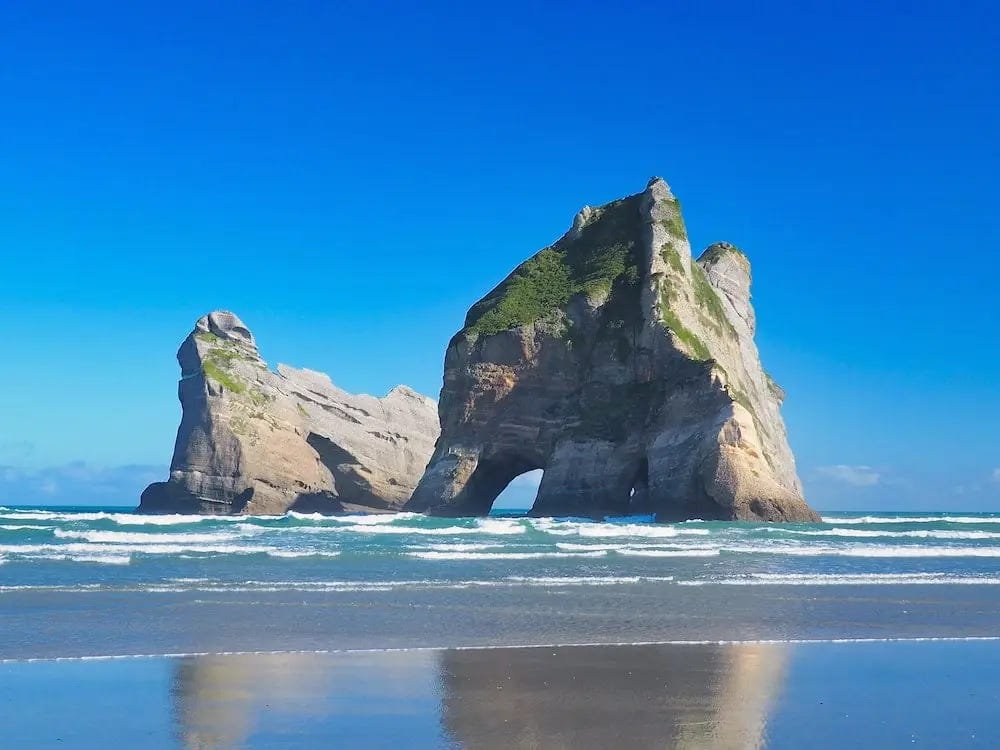
Wharariki Beach
Introduction
At the remote northwestern tip of New Zealand's South Island, where windswept farmland gives way to enormous dunes and the Tasman Sea crashes against sculpted cliffs, lies Wharariki Beach - one of the country's most dramatic and atmospheric coastal landscapes.
Located near Cape Farewell in the Golden Bay region of Nelson Tasman, Wharariki is not a conventional beach destination. There are no beachfront resorts, crowded promenades, or rows of restaurants. Instead, visitors walk across open farmland and through coastal forest before suddenly reaching a vast shoreline dominated by dunes, caves, rock pools, islands, and spectacular sea arches. New Zealand's official tourism authority describes Wharariki as a rugged, remote, and wild beach at the northernmost end of the South Island.
The most recognizable feature is the group of offshore rock formations known as the Archway Islands. Waves and wind have carved openings through the sandstone and limestone-like coastal formations, creating enormous natural arches that have become one of the visual symbols of the region.
Wharariki is also known for its wildlife. New Zealand fur seals, or kekeno, use pools and rocky areas around the beach, while the wider Farewell Spit region supports an extraordinary variety of coastal and migratory birds.
For travelers searching for unique places to visit in New Zealand, Wharariki Beach offers something increasingly rare - a spectacular coastline that still feels remote, natural, and largely untouched.
Geographical and Environmental Significance
Wharariki Beach is situated near the northernmost part of New Zealand's South Island, within the broader Farewell Spit and Pūponga landscape of Golden Bay. The coastline here is shaped by powerful ocean currents, strong winds, shifting dunes, cliffs, wetlands, and exposed rock formations.
Behind the beach, enormous sand dunes constantly change under the influence of wind. Beyond them are dune lakes, wetlands, coastal grasslands, and areas of native vegetation. The Department of Conservation describes the surrounding landscape as containing caves, islands, dunes, lakes, swamps, and diverse vegetation, including rare plant species.
The wider Farewell Spit landscape is particularly important for birds. Farewell Spit itself is New Zealand's longest sand spit, extending about 25 kilometers into the Tasman Sea. More than 90 bird species have been recorded in the area, including large numbers of migratory wading birds that arrive from the Northern Hemisphere during spring.
The meeting of land and ocean also creates important habitat for marine mammals. New Zealand fur seals are regularly seen around Wharariki, including young seals that use tidal pools as places to rest and play. The species, known in Māori as kekeno, is the most common seal species in New Zealand and is found around rocky coastal environments throughout the country.
The exposed location gives Wharariki a distinctly wild climate. Strong winds and rapidly changing coastal weather are common, and the beach is exposed to powerful surf. These conditions have helped shape the dunes and rock formations over long periods.
The landscape is therefore not simply a beautiful beach. It is part of a larger coastal ecosystem in which dunes, wetlands, forests, marine habitats, and bird sanctuaries interact.
Landscapes or Heritage
The defining landscape of Wharariki Beach is the Archway Islands, a group of rocky formations standing just offshore. Their enormous natural openings have been carved by the relentless action of waves, wind, and weather.
At low tide, visitors can walk along sections of the beach and approach viewpoints of the arches. The changing tide dramatically alters the appearance of the coastline. At one moment, waves may surround the rock formations, while hours later broad stretches of wet sand reflect the sky and cliffs.
The beach itself is enormous. Rather than being a compact strip of sand backed by development, it opens into a broad coastal wilderness. Giant dunes rise behind the shoreline, while rocky islands and cliffs dominate the horizon.
Caves and rock pools add another dimension to exploration. At low tide, sections of the coast reveal marine life and geological textures that remain hidden beneath the water at high tide. The combination of sand, cliffs, pools, caves, and arches makes Wharariki particularly rewarding for photographers.
The surrounding landscape also connects directly with Cape Farewell, the northernmost point of the South Island. A network of walking tracks links the beach with viewpoints, farmland, coastal cliffs, and the historic Pillar Point Lighthouse. The longer Pūponga Hilltop Walk passes through open farmland and along exposed coastal terrain before reaching Wharariki Beach.
Pillar Point Lighthouse adds a small but fascinating piece of maritime heritage. The track to the lighthouse climbs through the landscape and provides broad views across the surrounding coastline. Near the lighthouse are also remnants of a radar station built during World War II, providing a reminder of the strategic importance of this isolated coast.
The wider Farewell Spit landscape contains further traces of natural and human history, including fossil deposits, historic sites, and Māori heritage. The result is a coastline where geology, wildlife, maritime history, and traditional landscapes overlap.
Culture
Wharariki lies within a region with deep Māori cultural connections. Golden Bay and the wider northern South Island have long been inhabited and traveled by Māori communities, whose relationship with the coastline extends far beyond its modern identity as a tourism destination.
The Māori name Wharariki forms part of a landscape where traditional place names preserve connections to the environment and its history. Nearby Onetahua, the Māori name associated with Farewell Spit, reflects the area's cultural identity as well as its natural significance.
The coastal environment has historically provided food, transportation routes, and places of settlement. Beaches, estuaries, wetlands, and marine ecosystems were important resources for communities living in the region.
European history also became part of the landscape. Cape Farewell and Farewell Spit later developed connections with maritime navigation, while lighthouses and other coastal infrastructure reflected the challenges of navigating this exposed part of New Zealand.
Today, the region combines conservation, farming, outdoor recreation, and tourism. The Wharariki Beach walk crosses privately managed farmland before entering the coastal environment, creating an unusual transition from agricultural landscape to protected wilderness.
That combination is characteristic of the region. Wharariki does not feel like a separate theme park for nature; instead, it exists within a living cultural landscape where farms, conservation areas, historic sites, and coastal ecosystems exist alongside one another.
Cuisine
Wharariki Beach itself has almost no conventional visitor infrastructure, so the culinary experience is primarily found in nearby Golden Bay communities rather than directly on the sand.
The region's food culture reflects New Zealand's agricultural and coastal traditions. Local produce, seafood, dairy products, meat, fruit, vegetables, artisan breads, and locally produced cheeses feature strongly in the wider Nelson Tasman region.
Nearby Tākaka serves as the main town for many travelers exploring Golden Bay. Its cafés, bakeries, restaurants, and local food producers provide opportunities to experience regional ingredients before or after visiting the coast.
Fresh seafood is naturally important along the northern South Island coastline. Fish, shellfish, and other marine products connect the local food culture with the surrounding Tasman and Golden Bay waters.
Visitors staying in cottages, lodges, or holiday accommodation can also make use of local produce and farmers' markets. The experience is less about a single famous Wharariki dish and more about enjoying New Zealand's fresh, regional food after a day exploring the windswept coast.
Because the beach itself is remote and camping is not permitted in the Farewell Spit Nature Reserve and Pūponga Farm Park, travelers should plan meals and refreshments before setting out.
Sustainability
Wharariki's remote character depends heavily on careful conservation. The beach forms part of the Farewell Spit Nature Reserve and Pūponga Farm Park, an environmentally sensitive landscape managed by the Department of Conservation and other conservation partners.
Visitors are expected to take their rubbish away, avoid lighting fires, refrain from fishing in the nature reserve, and keep dogs and other pets away from the protected area. Camping is also prohibited within the reserve and farm park.
Wildlife protection is particularly important. Seals may appear surprisingly close to visitors, especially around pools used by pups. The Department of Conservation requires people to stay at least 20 meters away from seals and specifically warns visitors not to follow or chase them. Harassing seals is an offense under New Zealand's Marine Mammals Protection Act 1978.
The beach is also not recommended for swimming. Strong currents and rips make the exposed coastline considerably more dangerous than its beautiful appearance might suggest. The Department of Conservation advises visitors to experience Wharariki primarily as a walking and sightseeing destination.
Conservation work extends beyond visitor rules. Several organizations, including the Department of Conservation, Manawhenua ki Mohua, Pest Free Onetahua, and HealthPost Nature Trust, are working together to protect native species and improve the ecosystem around Farewell Spit. A predator-exclusion fence project across the Old Man Range is intended to protect approximately 2,000 hectares of habitat.
For visitors, sustainability is simple but important: stay on appropriate tracks, respect farmland gates and livestock, keep away from wildlife, avoid disturbing plants and dunes, and leave no trace.
Best Time to Visit
Wharariki Beach can be visited throughout the year, but conditions vary considerably.
Summer offers longer daylight hours and generally favorable conditions for exploring the beach, dunes, and surrounding walking tracks. It is also a popular period for road trips through Golden Bay, so visitors may encounter more people during peak holiday periods.
Spring brings an especially interesting natural atmosphere. The wider Farewell Spit region becomes important for migratory birds, with thousands of wading birds arriving from the Northern Hemisphere.
Autumn can provide quieter conditions and dramatic skies, while winter brings a stronger sense of isolation. The coastline can be cold and windy, but stormy weather can also create spectacular photography opportunities.
The most important consideration is the tide. New Zealand's official tourism information recommends visiting at low tide because this allows visitors to walk along more of the beach and see the caves, islands, rock pools, dunes, and arches from different perspectives.
Early morning and late afternoon are particularly attractive for photography because lower sunlight emphasizes the textures of the dunes and rock formations.
Whatever season you choose, bring windproof and waterproof layers. Weather on this exposed coastline can change quickly, and comfortable conditions in nearby Tākaka do not necessarily mean calm conditions at Wharariki.
Transport
Wharariki Beach is reached by road from Golden Bay. The closest significant town is Tākaka, and the official New Zealand tourism guide places the beach roughly one hour from Tākaka and about two and a half hours from Nelson by road.
From Tākaka, travelers follow State Highway 60 westward before turning onto Wharariki Road. The road eventually reaches the Wharariki car park, from where the beach is accessible on foot.
The final walk is part of the experience. The track passes through farmland and a section of coastal forest before descending toward the beach. The walk from the car park to the coast takes around 20 minutes, with the official track listed as an easy walk of approximately 2 kilometers return.
Travelers without a private vehicle can investigate shuttle or guided-tour options from Golden Bay, although independent visitors generally find a rental car the most flexible way to explore the region.
Tākaka Airport provides another option for reaching Golden Bay. It is a small regional airfield with scheduled flights connecting Tākaka and Wellington at certain times of year, while scenic flights operate over destinations including Farewell Spit and Wharariki.
Once at Wharariki, the landscape is explored on foot. Vehicles are not permitted along the beach, preserving its remote character and reducing disturbance to the coastal environment.
Why Visit
Wharariki Beach is one of those rare destinations where the journey is part of the attraction. Walking through farmland and forest before emerging onto a huge windswept beach creates a sense of discovery that is missing from destinations reached directly by road.
Its combination of sea arches, offshore islands, giant dunes, caves, rock pools, cliffs, and wildlife gives the coastline an almost cinematic appearance. The famous Archway Islands are particularly striking at low tide, when reflections and wet sand can transform the beach into a natural mirror.
Wildlife adds another layer to the experience. Seeing a New Zealand fur seal resting near a tidal pool or playing in shallow water can be memorable, but the experience is most meaningful when observed from a respectful distance.
The wider region also makes Wharariki ideal for a longer road trip. Visitors can combine the beach with Cape Farewell, Pillar Point Lighthouse, Farewell Spit, Golden Bay, and other landscapes of Nelson Tasman. The official walking network includes routes ranging from a short beach visit to longer hilltop and coastal walks.
For photographers, hikers, wildlife lovers, and travelers looking for unusual places to visit in New Zealand, Wharariki offers a coastline that feels much wilder than its accessibility might suggest.
Conclusion
Wharariki Beach is a spectacular expression of New Zealand's wild northern coastline. Here, the Tasman Sea meets enormous dunes, windswept farmland, coastal forest, caves, tidal pools, and towering natural arches.
Its beauty comes from its sense of space and isolation. There are no large developments competing with the landscape, and reaching the beach requires a short walk through a changing sequence of environments. Once the coastline appears, the scale of the dunes and sea arches creates an immediate impression of wilderness.
The seals, migratory birds, historic landmarks, Māori cultural connections, and surrounding conservation areas add depth to an already remarkable landscape. Most importantly, the area's protected status ensures that its wild character remains central to the visitor experience.
For anyone exploring New Zealand's South Island beyond its famous national parks and alpine scenery, Wharariki Beach offers a different kind of adventure - a windswept world of sand, stone, sea, and wildlife at the edge of the country.
00 Comments
No comments yet.
Leave a Comment