

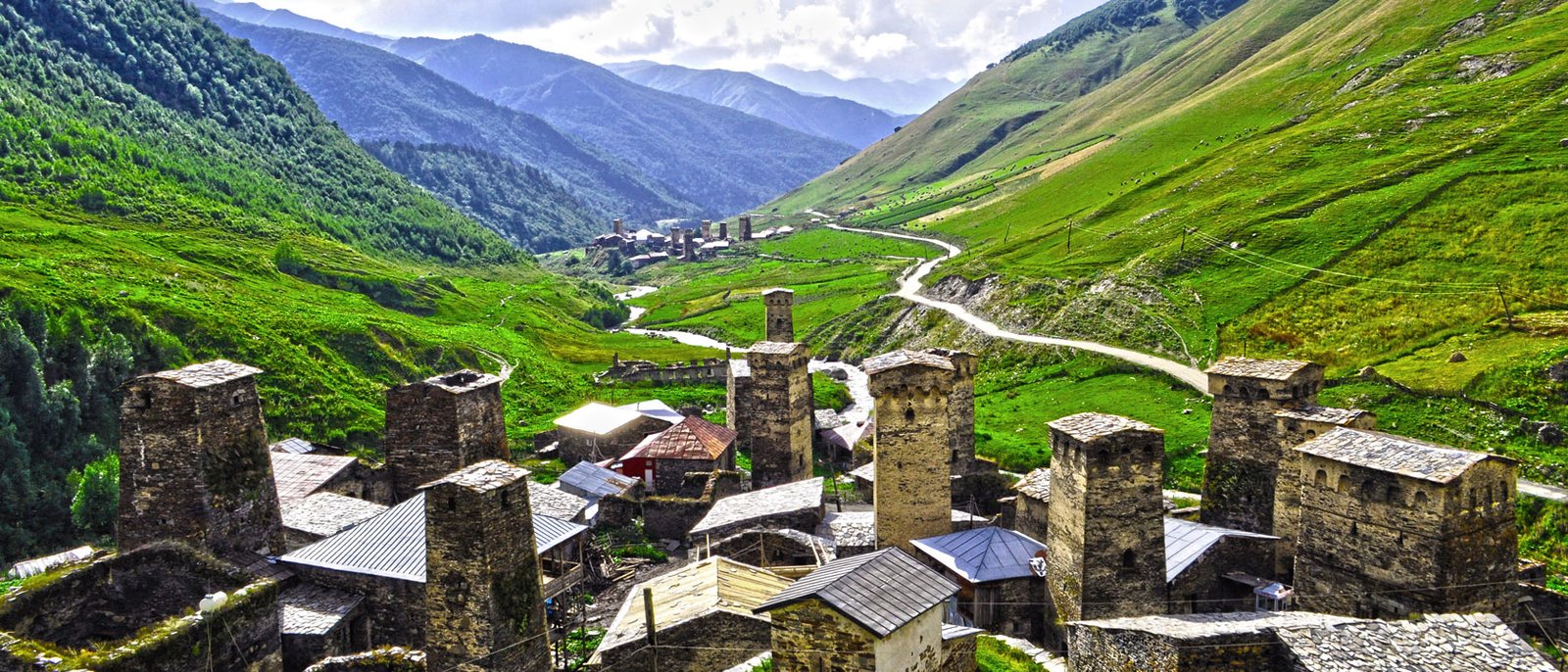
Upper Svaneti
Introduction
Far from the busy streets of Tbilisi and the Black Sea resorts of western Georgia, a remarkable world of stone villages, ancient traditions and towering mountains survives in the country's remote northwest. This is Upper Svaneti, a dramatic region of the Greater Caucasus where centuries-old defensive towers stand beside traditional homes and glaciers descend from some of Europe's most imposing mountain peaks.
The region's most recognizable landmarks are the Svan towers, tall stone structures that have protected families and settlements for generations. Rising above villages such as Mestia and Ushguli, they create a striking skyline against meadows, forested slopes and snow-covered mountains. Their unusual architecture reflects a history shaped by geographical isolation, harsh winters and the need for communities to protect themselves.
Upper Svaneti was inscribed on the UNESCO World Heritage List in 1996 because of its exceptional mountain scenery and remarkably preserved medieval settlements. The historic village of Chazhashi, within the Ushguli community, is particularly notable for its concentration of traditional tower houses, churches and other historic structures. <Cite refs={["turn693605search0","turn693605search1"]}/>
Yet Upper Svaneti is more than an architectural treasure. It is a living cultural landscape where the Svan people maintain distinctive traditions, local cuisine, music and a strong connection to their mountain homeland. Hiking trails lead toward glaciers and alpine lakes, village paths pass ancient stone buildings, and distant peaks dominate almost every view.
For travelers seeking unique places to visit in Georgia, Upper Svaneti offers an extraordinary combination of natural beauty, cultural heritage and mountain adventure. It is a destination where the past is not confined to museums but remains visible in the buildings, landscapes and everyday life of the communities.
Geographical and Environmental Significance
Upper Svaneti lies in the northwestern part of Georgia, within the mountainous region of Samegrelo-Zemo Svaneti. It occupies the upper reaches of the Enguri River basin, surrounded by the main Caucasus range and the Svaneti mountain range. The region's villages are scattered across valleys and mountain slopes, with high peaks and glaciers forming a spectacular natural backdrop. <Cite refs={["turn693605search0","turn693605search8"]}/>
Altitude defines the character of this landscape. Mestia, the region's principal town and main tourism centre, sits at approximately 1,500 metres above sea level. Ushguli, a community of historic mountain villages, lies at around 2,100 to 2,200 metres. Beyond the settlements, the mountains rise dramatically, culminating in the towering Caucasus peaks, including Mount Shkhara, Georgia's highest mountain at approximately 5,193 metres. <Cite refs={["turn693605search1","turn693605search7"]}/>
The landscape contains an extraordinary range of environments. Lower valley slopes support forests and agricultural land, while higher elevations contain alpine meadows, rocky ridges, glacial valleys and permanent snowfields. Mountain streams carry meltwater into the Enguri River system, linking the high glaciers with the villages below.
The region's geology has been shaped by immense tectonic forces that raised the Caucasus into one of the world's great mountain systems. Glaciers and rivers subsequently carved valleys and reshaped the terrain, leaving steep slopes, exposed rock faces and deep mountain basins. These processes continue to influence the landscape through erosion, seasonal meltwater and occasional landslides.
Upper Svaneti's climate changes significantly with altitude and season. Summers are generally mild in the higher villages, although conditions can change rapidly in the mountains. Winters bring heavy snowfall, freezing temperatures and periods when roads become difficult or impossible to use. Spring often arrives gradually, with snow lingering on higher trails even as flowers appear in the lower valleys.
This seasonal variation supports diverse plant and animal life. Forests provide habitat for birds and mammals, while alpine meadows support wildflowers and insects during the short growing season. The wider Caucasus is home to species such as chamois, brown bears, wolves and golden eagles, although sightings are never guaranteed.
The same environment that gives Upper Svaneti its extraordinary beauty has also shaped its human history. Isolation protected many settlements from outside influences, while the harsh climate encouraged compact villages, durable stone architecture and traditions adapted to mountain life.
Landscapes or Heritage
Upper Svaneti's defining feature is its remarkable collection of medieval tower houses. These structures, often three to five storeys high, rise above stone homes and narrow village lanes. Their thick lower walls and tapering profiles give them a distinctive appearance, while their elevated positions provide views across settlements and surrounding valleys. <Cite refs={["turn693605search0","turn693605search12"]}/>
Historically, the towers served as defensive structures and were closely connected to family life. During periods of danger, residents could retreat into them for protection. Their design reflected the social organization of Svan communities, where extended families maintained strong connections to their homes, land and local traditions.
Mestia, the principal town of Upper Svaneti, is an ideal starting point for exploring this heritage. Its old quarters contain numerous tower houses, traditional buildings and winding lanes, with the Caucasus peaks rising behind the settlement. The town also offers guesthouses, restaurants, shops and cultural attractions, making it a practical base for hiking and village excursions.
The Svaneti Museum of History and Ethnography in Mestia provides valuable context for understanding the region. Its collections include religious icons, manuscripts, traditional clothing and historical objects that illustrate the cultural development of Svaneti. Visiting the museum before exploring the surrounding villages can help travelers recognize the significance of the buildings and traditions they encounter.
Further into the mountains lies Ushguli, one of the most celebrated destinations in Georgia. The name refers to a community of several villages, including Chazhashi, Chvibiani, Zhibiani and Murkmeli. Set beneath Mount Shkhara, the settlements are known for their stone towers, open meadows and dramatic mountain views. <Cite refs={["turn693605search1","turn693605search13"]}/>
Chazhashi is especially important for its preserved medieval architecture. Its tower houses and historic buildings form part of the UNESCO World Heritage property, making the village one of the most significant places for understanding traditional Svan settlement patterns. Walking through its lanes reveals how homes, defensive structures and the natural environment were arranged as part of a coherent community.
Religious heritage is another major attraction. Lamaria Church near Ushguli is a notable historic church surrounded by mountain scenery. Small churches and chapels throughout Svaneti preserve traditional architecture and religious art, including medieval frescoes that reflect the region's distinctive artistic heritage.
The natural landscape offers equally compelling experiences. From Mestia, hiking routes lead toward Koruldi Lakes, where mountain reflections and panoramic views create one of the region's most famous trekking destinations. The Chalaadi Glacier trail provides access to a striking glacial landscape, while longer routes connect remote villages across alpine passes.
The classic multi-day trek from Mestia to Ushguli crosses mountain valleys and high terrain, passing through settlements such as Zhabeshi, Adishi and Iprali. The route reveals a quieter side of Svaneti, with stone villages, mountain streams, grazing land and expansive views across the Caucasus. Weather, trail conditions and river crossings require careful planning, particularly early and late in the hiking season. <Cite refs={["turn693605search3","turn693605search7"]}/>
Together, these historic settlements and natural landmarks make Upper Svaneti an unusually complete destination. The towers tell the story of human survival and community, while the mountains reveal the scale of the environment in which those traditions developed.
Culture
The culture of Upper Svaneti is closely associated with the Svan people, an ethnic group with a distinctive language, customs and historical identity within Georgia. For centuries, the region's geographical isolation helped preserve traditions that developed in close relationship with the surrounding mountains.
The Svan language belongs to the Kartvelian language family, which also includes Georgian and several other related languages. Although Georgian is the country's official language, Svan remains an important part of local cultural identity and is spoken within communities across Svaneti.
Family and community have traditionally played central roles in Svan life. Extended families maintained homes, farmland and livestock, while villages developed their own customs and systems of cooperation. The defensive towers themselves reflect these social structures, as they were associated with households and the need to protect family members and property.
Traditional music is another important part of the region's heritage. Svan polyphonic singing is known for its powerful harmonies and distinctive vocal arrangements. Songs have traditionally accompanied religious celebrations, community gatherings and important moments in village life. Alongside music, local dances, storytelling and oral traditions help preserve a strong sense of regional identity.
Religious traditions also remain visible throughout the landscape. Historic churches, icons and religious festivals connect communities with centuries of Georgian Christian heritage. Local celebrations may bring residents together for worship, food, music and social gatherings, particularly during warmer months when access to mountain villages is easier.
Agriculture and pastoralism continue to influence rural life. Families may keep cattle, produce dairy products, cultivate small plots and gather seasonal ingredients from the surrounding landscape. Summer grazing areas and mountain pastures remain important features of the region's traditional economy.
Tourism has introduced new opportunities through guesthouses, guiding, food services and handicrafts. However, Upper Svaneti's cultural appeal depends on more than its appearance. The traditions of the Svan people remain a living part of the region, and respectful travel means recognizing local customs, asking permission before photographing people and treating historic buildings as meaningful places rather than decorative scenery.
Cuisine
Svan cuisine reflects the practical needs of mountain life, combining hearty ingredients, dairy products, bread, potatoes, meat and regional herbs. The food is often warming and filling, making it particularly satisfying after a day spent hiking through the Caucasus.
One of the region's best-known specialties is kubdari, a traditional Svan meat-filled bread. The filling commonly contains chopped meat, onions and spices enclosed in dough and baked until golden. It is a popular local dish and a memorable introduction to the food culture of Svaneti.
Another distinctive ingredient is Svan salt, a seasoned salt mixture made with salt, garlic and a blend of herbs and spices. Recipes vary between households, but the seasoning is commonly used to enhance meat, potatoes, vegetables and other dishes. It is also a popular regional product for travelers to take home.
Georgian khachapuri, a cheese-filled bread, is widely enjoyed across the country, with regional variations in preparation. In Svaneti, breads and pastries are particularly welcome in the cooler mountain climate, and local bakeries or guesthouses may serve them fresh.
Dairy products are also important. Cheese, yogurt and butter feature in traditional meals, reflecting the longstanding role of cattle and seasonal grazing. Potatoes, beans and vegetables provide additional staples, while meat dishes are commonly served at family gatherings and in local restaurants.
Georgia's wider culinary traditions are well represented in Svaneti. Visitors may find khinkali dumplings, grilled meats, vegetable dishes, walnut-based sauces and seasonal produce alongside local specialties. Georgian wine is also part of the national food culture, although local offerings vary by restaurant and village.
Meals in Svaneti are often generous and communal. Family-run guesthouses may offer home-cooked dinners that introduce travelers to local ingredients and regional recipes. These meals can be one of the most rewarding aspects of a visit, providing a direct connection to the hospitality and everyday life of the mountain communities.
Sustainability
Protecting Upper Svaneti requires balancing tourism with the preservation of its historic architecture, fragile mountain environment and living cultural traditions.
The UNESCO World Heritage designation recognizes the exceptional value of the region's traditional settlements and tower houses. Conservation measures restrict inappropriate alterations to historic structures and aim to preserve the relationship between the villages and their natural setting. The challenge is to maintain these buildings while ensuring that residents can continue living and working in the communities. <Cite refs={["turn693605search0","turn693605search10"]}/>
Tourism provides valuable economic opportunities, particularly through locally operated guesthouses, restaurants, transport services and guiding. When visitors choose local businesses, more of the economic benefit remains in the region, supporting families who help maintain the villages and their traditions.
However, increasing visitor numbers can place pressure on historic buildings, roads, waste systems and hiking trails. New construction that ignores traditional architecture can weaken the character that makes Svaneti distinctive. Responsible development should respect local building traditions and avoid damaging the historic settlement pattern.
The mountain environment also requires care. Hikers should remain on established trails where possible, carry out their rubbish, avoid disturbing livestock and wildlife, and follow local advice on weather and river crossings. Alpine ecosystems recover slowly from damage, especially at higher elevations where vegetation has a short growing season.
Visitors should also be cautious around glaciers and unstable mountain terrain. Glacial rivers can rise rapidly, trails may be affected by rockfall, and conditions can change within hours. Hiring a qualified local guide for challenging hikes can improve safety while supporting regional expertise.
Climate change presents a longer-term challenge to the Caucasus. Changes in snowfall, glacier conditions and seasonal water availability can affect both natural ecosystems and communities that depend on mountain resources. Protecting forests, reducing waste and encouraging well-managed tourism are important elements of broader environmental stewardship.
Ultimately, sustainable travel in Upper Svaneti means preserving both its physical heritage and its living culture. The region's appeal depends on the continued presence of its residents, the survival of its traditional architecture and the health of the mountains that surround its villages.
Best Time to Visit
The best time to visit Upper Svaneti depends on whether your priority is hiking, cultural exploration, photography or winter sports.
Summer, from June to September, is generally the most practical season for trekking. Mountain trails become more accessible as snow melts, alpine meadows turn green and longer daylight hours allow time for excursions. July and August are particularly popular, so accommodation in Mestia and Ushguli should be booked ahead during busy periods. High mountain passes can still retain snow or be affected by weather, especially early in the season. <Cite refs={["turn693605search2","turn693605search7"]}/>
September and early October can be especially attractive for photographers. Autumn colours gradually spread through forests and valleys, the air often feels crisp, and the main summer rush begins to ease. These months can provide excellent conditions for village walks and scenic drives, although snowfall may affect high trails later in autumn.
Spring, from April to May, is a period of transition. Lower valleys begin to turn green, but high-altitude routes may remain snowy or muddy. Some roads and mountain passes may not yet be reliably accessible, so travelers planning to reach Ushguli or undertake long-distance treks should check current conditions.
Winter, from December to March, transforms the region into a snowy mountain landscape. Historic towers surrounded by snow create striking scenery, while Mestia becomes a base for skiing and snowboarding at the Hatsvali and Tetnuldi resorts. However, heavy snowfall can restrict road travel, and journeys to remote villages may require four-wheel-drive vehicles and careful planning. <Cite refs={["turn693605search1","turn693605search6"]}/>
For most first-time visitors, July through September offers the best balance of accessible trails, open guesthouses and opportunities to explore several villages. Travelers seeking autumn colours may prefer September or early October, while winter sports enthusiasts should plan around the ski season and local weather.
Regardless of the season, check road conditions and mountain forecasts before traveling. In Upper Svaneti, weather is not merely a background detail; it can determine which villages, passes and trails are safely accessible.
Transport
Reaching Upper Svaneti is part of the adventure. Its mountain location makes travel slower than distances on a map might suggest, and weather can influence both road journeys and flights.
Most visitors use Mestia as their main base. The usual overland route runs from Zugdidi through the Enguri valley toward the mountains. Zugdidi is connected to Georgia's railway network, making it a useful transfer point for travelers arriving from Tbilisi. Shared minibuses, private transfers and organized tours operate along the route, although departure times and availability can vary.
From Tbilisi, the journey to Mestia can take around eight hours or longer by road, depending on conditions and stops. Kutaisi is another practical starting point and is generally closer to the region. Small aircraft sometimes connect Mestia with other Georgian destinations, but flights are weather-dependent and should not be treated as a guaranteed option. <Cite refs={["turn693605search2","turn693605search8"]}/>
Once in Mestia, the town is compact enough to explore on foot. Tower houses, restaurants, accommodation and the local museum are within reach of the central area. For nearby trailheads and remote settlements, travelers can use local taxis, shared four-wheel-drive vehicles, organized excursions or guided hikes.
Ushguli lies roughly 45 to 46 kilometres from Mestia, but the mountain road can take two to three hours or more. Gravel sections and difficult conditions mean that a suitable four-wheel-drive vehicle is generally recommended. Road access may be interrupted by snow, heavy rain or landslides. <Cite refs={["turn693605search1","turn693605search12"]}/>
Travelers planning the Mestia-to-Ushguli trek should arrange accommodation in advance, especially during the summer season. The multi-day route passes through remote settlements where services are limited, and the itinerary needs to account for weather, trail conditions and river crossings.
For shorter visits, an organized day trip from Mestia can provide an introduction to Ushguli's towers and mountain scenery. However, staying overnight offers a more rewarding experience, with time to explore the villages after day visitors leave and to appreciate the changing light on the surrounding peaks.
Why Visit
Upper Svaneti stands out because it brings together experiences that are rarely found in one destination. Its medieval towers provide an extraordinary glimpse into the past, while its glaciers, mountain valleys and alpine meadows offer some of the most impressive scenery in Georgia.
For history enthusiasts, the traditional villages reveal how communities adapted their architecture and social structures to centuries of isolation. For photographers, the contrast between ancient stone buildings and snow-covered peaks creates striking compositions in every season. For hikers, trails lead toward glaciers, lakes and remote settlements where the scale of the Caucasus becomes unmistakable.
The region also offers a meaningful cultural experience. Svan music, local cuisine, traditional hospitality and the distinctive Svan language all contribute to a strong sense of identity. Staying in a family-run guesthouse can turn a mountain trip into an opportunity to learn about everyday life in one of Georgia's most distinctive regions.
Upper Svaneti is particularly rewarding for travelers who prefer places with a strong sense of place rather than conventional tourist attractions. The villages are not simply preserved monuments. They remain communities shaped by agriculture, family traditions and the challenges of mountain living.
Its remoteness does require planning, and the weather can restrict access to some areas. Yet these practical challenges are part of what makes the journey memorable. Reaching Ushguli, walking between tower houses or seeing Mount Shkhara emerge from the clouds can feel like discovering a different world.
For anyone building a travel guide to unique destinations in the Caucasus, Upper Svaneti deserves a prominent place. It offers history, architecture, natural beauty and outdoor adventure without losing the authenticity that makes the region special.
Conclusion
Upper Svaneti is one of Georgia's most remarkable destinations, where ancient stone towers rise from mountain villages beneath the immense peaks of the Greater Caucasus. Its UNESCO-recognized heritage, dramatic landscapes and enduring Svan traditions create an experience that goes far beyond sightseeing.
From the historic lanes of Mestia to the medieval towers of Ushguli, the region reveals a long relationship between people and the mountains. Its architecture reflects centuries of adaptation, its cuisine celebrates the resources of the highlands, and its trails open the door to glaciers, alpine meadows and remote valleys.
Visiting requires preparation, particularly when traveling beyond Mestia or exploring high mountain routes. But for those willing to slow down and embrace the journey, Upper Svaneti offers rewards in every direction: a tower silhouetted against a snowy peak, the sound of traditional music in a village, a warm meal after a long hike or the first clear view of Mount Shkhara.
In a world where many historic destinations have become crowded and commercialized, Upper Svaneti retains a remarkable sense of continuity. It is a place where history remains part of daily life and where the mountains continue to shape the rhythm of the communities below.
For travelers seeking the ancient towers of the Caucasus, Upper Svaneti is not simply a destination to photograph. It is a landscape to explore, a culture to appreciate and a reminder of the enduring connection between human heritage and the natural world.
00 Comments
No comments yet.
Leave a Comment