

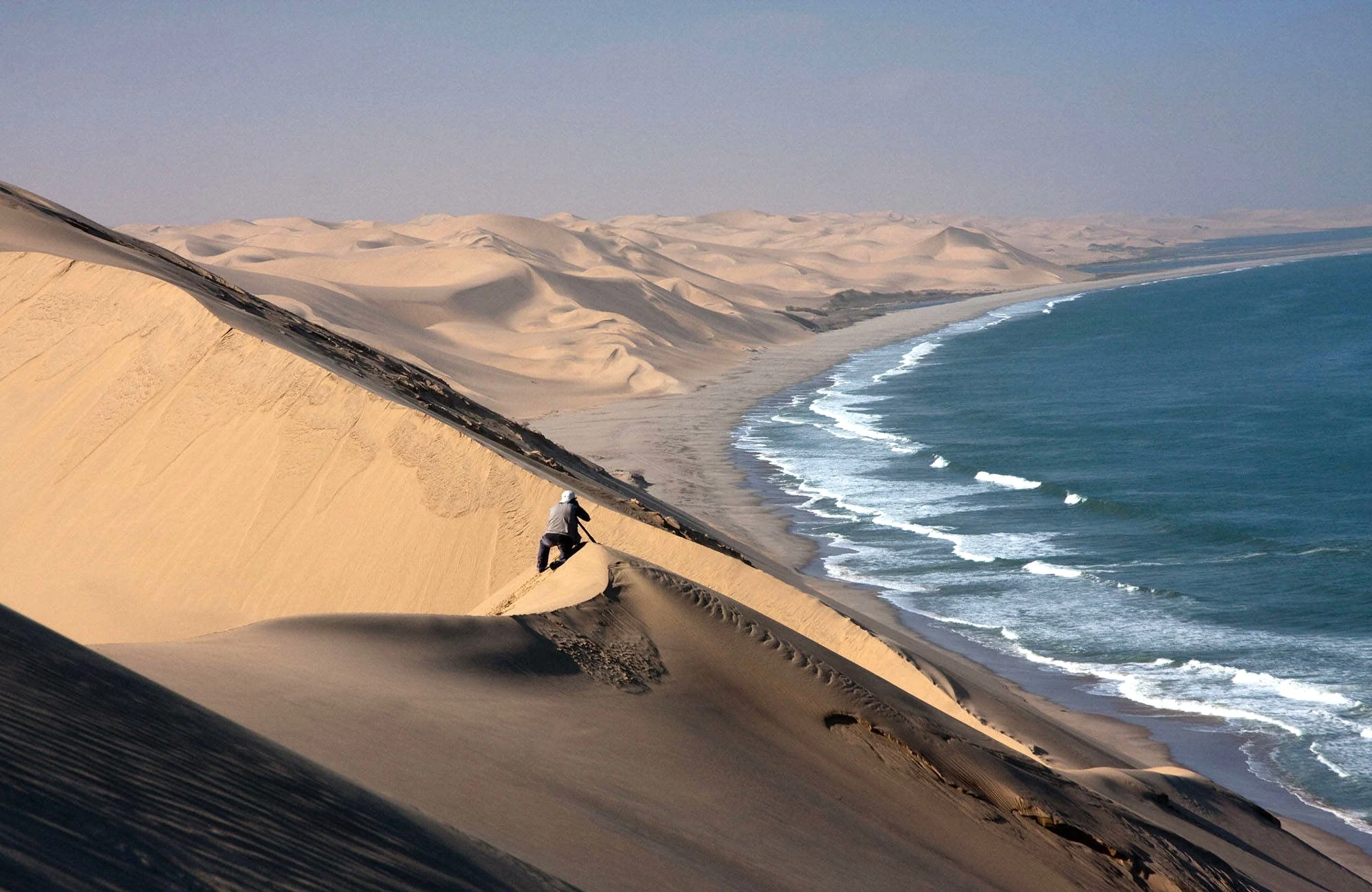
Skeleton Coast
Introduction
On the remote northwestern coast of Namibia, where the vast Namib Desert meets the cold waters of the Atlantic Ocean, lies one of Africa's most extraordinary wilderness landscapes - the Skeleton Coast. Stretching along a rugged coastline of dunes, gravel plains, fog-shrouded beaches, rocky cliffs, and ephemeral river valleys, this isolated region feels almost otherworldly.
The name Skeleton Coast comes from the remains scattered along its shores. Shipwrecks, whale and seal bones, and other remnants of the harsh maritime environment have contributed to the coast's haunting reputation. Yet beneath its stark appearance is an ecosystem of remarkable complexity. The cold Benguela Current brings nutrient-rich waters toward the coast, while dense ocean fog provides moisture in a desert where rainfall is exceptionally scarce. Namibia's Ministry of Environment and Tourism describes the Skeleton Coast as one of the country's greatest treasures and one of the world's last great wildernesses.
The protected Skeleton Coast Park extends for approximately 500 kilometers from the Ugab River in the south toward the Kunene River in the north and reaches roughly 40 kilometers inland. Covering about 16,390 square kilometers, it is an enormous landscape where desert and ocean exist in constant contrast.
Despite its forbidding reputation, the Skeleton Coast is alive with wildlife. Desert-adapted elephants and lions move through dry river valleys, while seals, dolphins, turtles, seabirds, and other marine species inhabit the coastal environment. The result is a destination where isolation is not simply a feature - it is part of the attraction.
For travelers searching for unique places to visit in Namibia, the Skeleton Coast offers an experience unlike almost anywhere else: endless desert, cold Atlantic surf, mysterious fog, ancient geology, wildlife, and the unforgettable feeling of standing at the edge of one of Earth's great wildernesses.
Geographical and Environmental Significance
The Skeleton Coast occupies the northwestern edge of Namibia, forming part of the immense Namib Desert landscape. Its defining geographical feature is the meeting of two extreme environments - an exceptionally dry desert and the cold Atlantic Ocean.
The cold Benguela Current flows northward along the coast, bringing cold, nutrient-rich water from the southern Atlantic. When this cold ocean air meets the warmer desert atmosphere, dense coastal fog can develop. These fogs are one of the defining characteristics of the Skeleton Coast and provide an important source of moisture for organisms adapted to one of the world's driest environments.
Rainfall is extremely limited, yet the landscape supports surprising biological diversity. Lichen fields cover portions of the coastal plains, while specialized plants such as the narra plant, dollar bush, and vygies survive in the harsh environment. Along ephemeral riverbeds, conditions become more favorable, allowing species such as mopane, wild tamarisk, and makalani palms to grow.
The park's geology is equally diverse. Sandy and pebble beaches give way to dunes, gravel plains, ephemeral riverbeds, canyons, rugged volcanic rock formations, and inland mountain ranges. These contrasting landscapes create a series of ecological zones within a single protected area.
The dry river systems are particularly important. Although they may remain empty for long periods, occasional rainfall far inland can send temporary flows toward the coast. These rivers create narrow corridors of vegetation and wildlife through the desert.
The northern part of the region also includes the Kunene River mouth, an important wetland where the river reaches the Atlantic. This freshwater environment creates an extraordinary contrast with the surrounding desert and supports birds and other wildlife.
The Skeleton Coast therefore demonstrates how life can adapt to seemingly impossible conditions. Fog replaces regular rainfall, riverbeds become temporary oases, and marine productivity supports wildlife along a coastline that otherwise appears almost barren.
Landscapes or Heritage
The landscapes of the Skeleton Coast are defined by extremes. The ocean can appear calm and silver beneath the fog one moment, while enormous waves crash against the shore the next. Behind the beaches, dunes and gravel plains stretch toward distant mountains, creating a sense of immense scale.
Shipwrecks are among the coast's most recognizable features. Strong currents, dense fog, heavy surf, offshore rocks, and limited visibility historically made navigation difficult, leaving vessels stranded along the shoreline. The remains of wrecks have become part of the landscape and helped create the area's distinctive name and reputation. Namibia's government tourism authorities specifically identify the shipwrecks as reminders of the difficult relationship between people and this unforgiving coastline.
One of the most famous wrecks associated with the region is the Eduard Bohlen, a German cargo ship that ran aground in 1907 near Conception Bay. Today, its remains are surrounded by shifting sand and are gradually being reclaimed by the desert.
Another important coastal attraction is the large Cape fur seal colony at Cape Cross, located south of the Skeleton Coast National Park. Tens of thousands of seals may gather in the area at different times of the year, creating one of Namibia's most remarkable wildlife spectacles.
Farther north, the landscape becomes increasingly remote. The Hoanib, Hoarusib, and other ephemeral river valleys cut through the desert, creating wildlife corridors where desert-adapted elephants, lions, giraffes, oryx, and other animals can survive.
The Kunene River forms the northern boundary of Namibia before reaching the Atlantic, and its mouth creates one of the most striking environmental transitions in the region. Desert, river, wetland, and ocean meet within a relatively small area.
The landscape also carries an archaeological and cultural heritage connected with Indigenous communities and centuries of movement through the Namibian desert. The harsh environment shaped traditional patterns of settlement and travel, while knowledge of water sources, wildlife, plants, and seasonal conditions remains an important part of life in the wider region.
The Skeleton Coast's heritage is therefore not limited to shipwrecks. It encompasses geology, desert ecology, Indigenous knowledge, wildlife, and the long relationship between people and one of the most demanding environments on Earth.
Culture
The Skeleton Coast itself is largely wilderness, but its cultural story is connected with the people who have lived in and traveled through Namibia's northwestern landscapes.
The wider Kunene region is strongly associated with the Himba people, whose traditional communities have developed ways of living adapted to the arid environment. Their knowledge of livestock, seasonal water sources, plants, and desert conditions reflects a deep relationship with the surrounding landscape.
The desert also carries the history of the San and other communities whose movements through Namibia predate modern national borders and protected areas. For these communities, the desert was never simply empty land. It was a landscape containing water sources, food, wildlife, routes, and places of cultural significance.
European maritime history added another layer to the region's identity. The dangerous coastline became notorious among sailors, and the wrecks scattered along the beaches became physical reminders of the hazards of the Atlantic.
Today, tourism forms another part of the cultural landscape. Safari guides, conservation workers, local communities, researchers, and tourism operators all contribute to the way visitors experience the Skeleton Coast.
Namibia's broader conservation model also places importance on community participation. The country's Ministry of Environment, Forestry and Tourism identifies community-based natural resource management as an important component of its conservation approach, linking wildlife protection with sustainable development and community benefits.
This connection is particularly important in a destination where wildlife moves beyond park boundaries and where conservation cannot be separated from the communities living around protected areas.
Cuisine
Food in the Skeleton Coast region is generally connected with Namibian cuisine rather than a distinctive coastal culinary tradition. Because much of the area is extremely remote, meals for visitors are commonly provided by lodges, camps, safari operators, and organized expeditions.
Namibian cuisine reflects influences from Indigenous traditions, German colonial history, South African food culture, and the country's pastoral communities.
Meat features prominently in many traditional and contemporary meals. Oryx, springbok, kudu, and other game meats are commonly encountered in Namibia, particularly in safari lodges and restaurants.
Kapana, a popular Namibian street-food tradition, consists of grilled meat prepared over an open flame and served with sauces and accompaniments. Although more strongly associated with urban markets, it provides an excellent introduction to Namibia's casual food culture.
Other dishes and ingredients include maize-based staples, mahangu or pearl millet, beans, vegetables, freshwater and marine fish, and traditional dried meats such as biltong.
Along the coast, seafood can also appear on menus, particularly in towns such as Swakopmund and Henties Bay farther south of the Skeleton Coast.
For travelers staying at remote lodges or joining multi-day safaris, dining can become part of the wilderness experience itself. Meals are often served around camp after long days of exploring, with the desert landscape providing a backdrop that is just as memorable as the food.
Sustainability
Few destinations demonstrate the importance of conservation more clearly than the Skeleton Coast. Its ecosystems are extremely fragile, and even small disturbances can take years or decades to disappear.
The Skeleton Coast Park was established to protect this vast desert-coastal environment, and Namibia's current conservation planning emphasizes maintaining biodiversity, ecosystem processes, sustainable tourism, and the long-term protection of natural resources.
One of the major environmental concerns is off-road driving. Vehicle tracks can remain visible across desert surfaces for extraordinarily long periods because vegetation grows slowly and natural recovery is limited. Namibia's tourism authorities specifically identify off-road driving as a management problem because vehicle scars can remain for centuries.
Visitors should therefore remain on designated routes and never drive across sensitive desert surfaces simply to approach wildlife or reach a better photographic position.
Wildlife viewing also requires patience and distance. Desert elephants, lions, rhinos, and other animals should never be approached too closely or disturbed for photographs.
The marine environment requires equal care. Seals, dolphins, turtles, and seabirds are vulnerable to disturbance and pollution, while plastic waste can cause serious harm to coastal wildlife.
The park's management approach also recognizes the importance of linking conservation with neighboring communal areas, conservancies, and other protected landscapes. Namibia has been working toward larger connected conservation landscapes, including cooperation involving the Skeleton Coast and Angola's Iona National Park.
For travelers, responsible tourism means using authorized operators, respecting access restrictions, minimizing waste, avoiding off-road driving, and supporting conservation-focused businesses and local communities.
Best Time to Visit
The Skeleton Coast can be visited at different times of the year, but conditions vary considerably.
The coastal climate is strongly influenced by the Benguela Current, which means the shoreline can be considerably cooler and foggier than inland Namibia. Early mornings can be particularly misty, while temperatures may rise farther inland during the day.
The cooler months from roughly May to October are generally attractive for exploring Namibia because daytime temperatures are more comfortable and rainfall is limited. These conditions can make long drives and wildlife viewing more pleasant.
Winter does not mean warm coastal weather, however. Travelers should bring layers because the combination of cold ocean air, wind, and fog can make the Skeleton Coast feel surprisingly chilly.
The summer months from November through April can be warmer, while occasional rainfall may bring temporary changes to inland river systems and vegetation. Wildlife conditions can also shift depending on rainfall.
For photography, the foggy atmosphere is not necessarily a disadvantage. In fact, mist is one of the defining visual characteristics of the Skeleton Coast. It can create dramatic scenes of shipwrecks, dunes, beaches, and mountains emerging from the haze.
Because access is regulated and many areas are extremely remote, travelers should plan their visit carefully rather than arriving without arrangements. The Ministry of Environment and Tourism states that entry into the Skeleton Coast Park requires a booking, while accommodation and camping options are limited.
Transport
The remoteness of the Skeleton Coast is one of its defining characteristics, and reaching the park requires considerably more planning than visiting Namibia's better-known destinations.
The southern gateway is generally approached from the Ugab River area, while the northern sections extend toward the Kunene River. The coastal road and surrounding routes are remote, and travelers should not expect frequent fuel stations, shops, or conventional tourist infrastructure.
Many visitors experience the Skeleton Coast through organized 4x4 expeditions or fly-in safari operators. This is particularly important for the northern sections, where distances are enormous and navigation can be challenging.
The nearest major urban centers for organizing a trip are Swakopmund, Walvis Bay, and Henties Bay farther south, depending on the route.
Road travel through the wider Skeleton Coast region generally requires a capable four-wheel-drive vehicle, appropriate supplies, careful route planning, and experience with remote desert travel.
The park's official information also makes clear that access is regulated. Visitors must have a booking to enter the park, while fishing requires an appropriate licence. Accommodation at Terrace Bay is limited, and camping there is permitted only during December and January according to current park information.
For travelers unfamiliar with Namibia's remote desert conditions, an experienced operator is the safest and most practical way to explore the region.
Why Visit
The Skeleton Coast is for travelers who want to experience a landscape that feels genuinely remote.
There are no tropical beaches, crowded promenades, or large resort developments here. Instead, there is the sound of Atlantic waves, the movement of coastal fog, the endless Namib Desert, and the occasional sight of wildlife moving through an otherwise seemingly empty landscape.
The contrast between desert and ocean is perhaps the destination's greatest attraction. Massive sand dunes can exist only a short distance from cold Atlantic waters, while fog can roll inland across landscapes that receive almost no conventional rainfall.
Wildlife adds another extraordinary dimension. Desert-adapted elephants and lions demonstrate the ability of large mammals to survive in extreme environments, while oryx, springbok, zebra, birds, dolphins, turtles, and other species occupy different ecological niches. The park records more than 300 bird species.
For photographers, the Skeleton Coast offers an almost endless collection of unusual subjects - shipwrecks, fog, dunes, seals, wildlife, volcanic cliffs, river valleys, and immense empty beaches.
For adventure travelers, the isolation itself becomes part of the experience. Reaching a remote section of the coast by 4x4 or small aircraft and spending time far from conventional infrastructure creates a sense of wilderness that is increasingly difficult to find.
Most importantly, the Skeleton Coast challenges the idea that a desert must be lifeless. Beneath its stark appearance is a sophisticated ecosystem shaped by fog, ocean currents, rivers, geology, and remarkable adaptation.
Conclusion
Skeleton Coast, Namibia, is a destination defined by contrasts. It is one of the driest landscapes on Earth, yet it supports elephants, lions, rhinos, seals, dolphins, turtles, birds, lichens, and specialized desert plants. It is a place where endless sand meets a powerful ocean and where fog becomes a source of life.
The Skeleton Coast Park protects approximately 16,390 square kilometers of this extraordinary environment, stretching for around 500 kilometers along Namibia's northwestern coastline.
Its shipwrecks and bones may have given the coast its haunting name, but its real story is one of survival. Life has adapted to extreme dryness, cold ocean currents, shifting dunes, powerful surf, and almost complete isolation.
For travelers seeking unique places to visit in Namibia, the Skeleton Coast offers something far beyond a conventional sightseeing experience. It is a journey into a landscape where nature appears stark and empty at first glance, only to reveal remarkable life and beauty the longer you remain.
Here, the desert does not simply end at the ocean. It meets the Atlantic in one of the most dramatic wilderness landscapes on Earth.
00 Comments
No comments yet.
Leave a Comment