

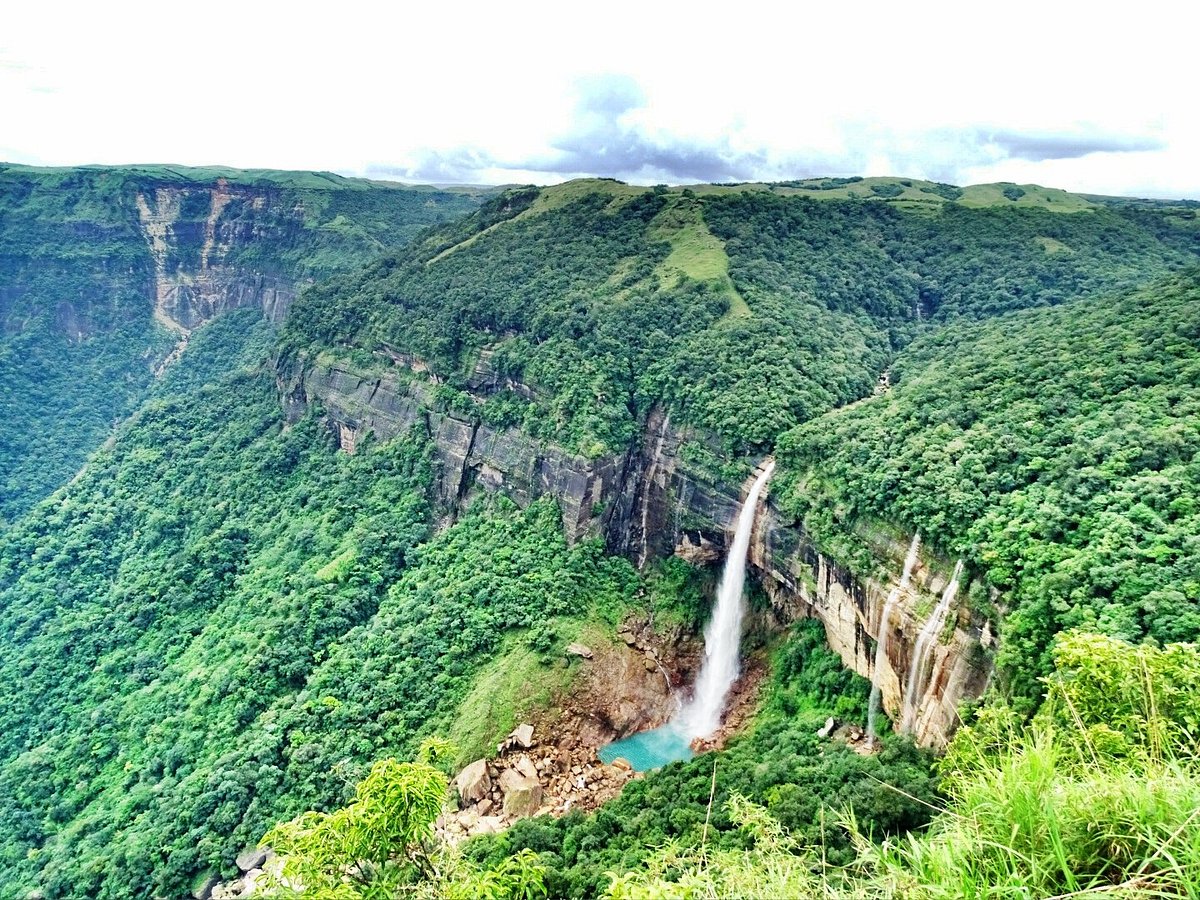
Nohkalikai Falls
Introduction
On the mist-covered plateau of Meghalaya's East Khasi Hills, where clouds drift across deep green valleys and rain shapes almost every aspect of the landscape, Nohkalikai Falls makes one of India's most dramatic natural appearances. Near the famous hill town of Sohra, formerly known as Cherrapunji, the waterfall drops in a spectacular 340-meter plunge from the forested plateau into a striking blue-green pool far below. Meghalaya Tourism describes Nohkalikai as one of India's tallest and most breathtaking plunge waterfalls.
The waterfall is not simply impressive because of its height. Its setting gives it a distinctive character. Sheer cliffs disappear into mist, dense vegetation covers the surrounding hillsides, and during the rainy season the narrow stream can transform into a powerful white torrent. When sunlight breaks through the clouds, the water and pool below contrast dramatically with the deep green landscape.
Nohkalikai is also connected to one of Meghalaya's most haunting local legends, the story of Ka Likai. The tragic tale has been passed down through generations and gives the waterfall a cultural identity that goes far beyond its physical beauty.
Located only about 7.5 kilometers from Sohra, Nohkalikai is relatively accessible while still feeling connected to the wild landscapes for which Meghalaya is famous.
For travelers looking for unique places to visit in India, Nohkalikai Falls offers a remarkable combination of geology, monsoon scenery, Khasi heritage, dramatic viewpoints, and one of the most unforgettable waterfall landscapes in Northeast India.
Geographical and Environmental Significance
Nohkalikai Falls is located in the East Khasi Hills district of Meghalaya, on the edge of the elevated plateau around Sohra. The region is internationally known for its extraordinary rainfall, which has helped shape its deep valleys, cliffs, caves, waterfalls, forests, and streams.
Unlike waterfalls that depend mainly on a large permanent river, Nohkalikai is strongly influenced by the seasonal rainfall of the plateau. Rainwater collected across the elevated landscape feeds the stream before it reaches the cliff and plunges into the gorge below. Meghalaya Tourism notes that the waterfall is fed by rainwater collected on a small plateau.
This relationship between rainfall and landscape is central to understanding the geography of Sohra. Over immense periods of time, water has cut through the Khasi plateau, producing steep escarpments and dramatic gorges. The waterfall is one spectacular expression of this larger geological process.
The surrounding environment is characterized by lush vegetation, rocky cliffs, streams, caves, and deep valleys. During the monsoon, the landscape becomes intensely green, while mist frequently moves through the hills and obscures distant views.
The region's forests also support a rich variety of plant and animal life. Meghalaya's wet climate creates habitats for numerous birds, insects, amphibians, and forest species, making the wider Sohra area particularly attractive to nature lovers.
Nohkalikai's environmental significance therefore comes not only from the waterfall itself but from the larger water system and high-rainfall ecosystem that surrounds it.
Landscapes or Heritage
The first sight of Nohkalikai Falls is best experienced from the designated viewpoint overlooking the gorge. From here, the waterfall appears as a long white ribbon dropping almost vertically against enormous green cliffs.
At 340 meters, the plunge is immense. The water disappears into the deep gorge before reaching the distinctive pool below, whose color can vary between blue and green depending on light, weather, and water conditions.
During the monsoon, the waterfall becomes particularly powerful. Rainfall increases the flow, while clouds and mist frequently surround the cliffs. At times, smaller streams also appear along the surrounding escarpments, turning the entire mountainside into a temporary network of waterfalls.
Yet the weather can also make Nohkalikai unpredictable. Clouds may completely obscure the falls, especially in the wettest conditions. This is part of the character of Sohra - visitors may arrive expecting a clear panorama and instead encounter a wall of mist, only for the waterfall to suddenly emerge when the clouds shift.
The landscape around Nohkalikai also connects with the wider attractions of Sohra. Mawsmai Cave, Arwah Cave, Seven Sisters Falls, and other viewpoints and valleys can be incorporated into a broader exploration of the region. The area is particularly rich in caves and dramatic limestone landscapes.
The waterfall itself is also a place of cultural heritage because its name is connected to the tragic legend of Ka Likai. According to the traditional story, Likai was a woman from the surrounding area whose life ended tragically after the death of her child. The waterfall's Khasi name, Nohkalikai, is commonly translated as "the leap of Ka Likai."
The story is deeply tragic, and it is best understood as part of local oral tradition rather than simply as a tourist attraction. It gives the waterfall an emotional dimension that distinguishes it from many other spectacular waterfalls around the world.
Culture
Nohkalikai lies within the cultural landscape of the Khasi people, one of the major Indigenous communities of Meghalaya. The Khasi have a strong historical relationship with the forests, hills, rivers, and rainfall of the region.
The cultural identity of Sohra is closely connected to its environment. Rain is not simply a weather phenomenon here - it has influenced architecture, agriculture, transportation, local traditions, and everyday life for generations.
The legend of Ka Likai is perhaps the most direct cultural connection associated with the waterfall. Its continued telling demonstrates how landscapes in Meghalaya are often connected to stories, memories, and community traditions.
The wider Sohra region is also famous for its living root bridges. Created by guiding the roots of rubber fig trees across streams and gorges, these remarkable structures demonstrate the traditional ecological knowledge of local communities. They are living examples of how people have adapted to an exceptionally wet and rugged environment.
Local handicrafts are another part of the cultural experience. Bamboo and cane have traditionally been important materials in Meghalaya, with artisans producing baskets, mats, furniture, hats, and other practical objects. Incredible India highlights bamboo and cane craftsmanship as part of Sohra's local artisanal traditions.
Visitors who explore Nohkalikai and the surrounding villages therefore encounter more than spectacular scenery. They enter a landscape where nature, oral history, traditional knowledge, and community life remain closely connected.
Cuisine
Food in the Sohra region reflects the broader culinary traditions of Meghalaya and the Khasi community. Local cuisine is generally straightforward, fresh, and closely connected to ingredients available in the surrounding hills.
Rice is an important staple, often accompanied by meat, fish, vegetables, and local herbs. Pork is particularly common in Khasi cuisine, while chicken and fish are also widely eaten.
Traditional preparations often emphasize the natural flavor of ingredients rather than heavy sauces or elaborate spices. Smoked and fermented ingredients are also important in parts of Meghalaya's culinary tradition.
One local specialty visitors may encounter is dohneiihong, a Khasi pork preparation traditionally cooked with black sesame. Another is doh khleh, a pork salad prepared with onions and other ingredients.
Rice-based meals, seasonal vegetables, bamboo shoots, and locally available herbs also appear in regional cooking. For travelers unfamiliar with northeastern Indian cuisine, Sohra provides an opportunity to experience flavors quite different from those commonly associated with Indian food elsewhere in the country.
Small local restaurants and homestyle eateries are often the best places to experience regional food. Trying local Khasi dishes can add an important cultural dimension to a visit that might otherwise focus entirely on waterfalls and viewpoints.
Sustainability
The beauty of Nohkalikai exists within a fragile high-rainfall environment, making responsible tourism particularly important.
The cliffs, forests, streams, and surrounding valleys are vulnerable to erosion, litter, uncontrolled development, and heavy visitor pressure. As tourism in Meghalaya continues to grow, protecting the landscape around major attractions becomes increasingly important.
Visitors should stay within designated viewing areas and avoid approaching unstable cliff edges. The combination of steep terrain, wet surfaces, fog, and heavy rainfall can create dangerous conditions even when the weather appears manageable.
Waste management is another important consideration. Travelers should carry their waste out when appropriate, avoid single-use plastics, and use established facilities rather than leaving rubbish in the surrounding forest or gorge.
Supporting local businesses can also make tourism more beneficial to surrounding communities. Hiring local guides, eating at locally operated establishments, purchasing regional handicrafts, and choosing responsible accommodation can help ensure that tourism contributes to the local economy.
The Meghalaya Tourism Department has also been developing and upgrading visitor infrastructure around Nohkalikai. A 2026 Government of Meghalaya tender, for example, concerned the development of a viewing area at Wahkaliar Viewpoint.
Responsible development should maintain the balance between accessibility and the natural character of the site. Nohkalikai's greatest attraction is its landscape, so protecting that landscape must remain central to its future.
Best Time to Visit
The best time to visit Nohkalikai Falls depends on whether you want maximum water flow or better visibility.
The monsoon season from June to September brings the greatest rainfall to Meghalaya and can transform Nohkalikai into a spectacular torrent. Incredible India specifically recommends the monsoon months for experiencing the waterfall at its most powerful.
However, heavy monsoon weather can also bring thick cloud, mist, slippery roads, and difficult travel conditions. The waterfall may sometimes disappear completely behind clouds.
For a combination of strong waterfall flow and improved viewing conditions, the period after the main monsoon can be especially appealing. Meghalaya Tourism currently recommends October through December, when the monsoon has enhanced the waterfall while conditions can be more favorable for sightseeing.
The drier winter months can provide clearer skies and easier travel, although the waterfall's flow may be less dramatic than during the rainy season.
Early morning or later afternoon can also provide attractive light, depending on the weather. Because clouds are an important part of the landscape, flexibility is useful - a short wait at the viewpoint can sometimes turn a completely hidden waterfall into a spectacular panorama.
Transport
Nohkalikai Falls is relatively easy to reach compared with many of Meghalaya's more remote natural attractions.
The waterfall is approximately 7.5 kilometers from Sohra, making the town the most convenient base for visitors. Meghalaya Tourism states that cabs and local transportation can be taken from Shillong or Guwahati to Sohra, followed by roughly a 20-minute drive to the falls.
For travelers arriving by air, Shillong Airport is approximately 79 kilometers away, while Guwahati Airport is approximately 167 kilometers from Nohkalikai according to Meghalaya Tourism. Guwahati generally provides the more practical gateway for many travelers because of its larger number of flight connections.
The nearest major railway station is Guwahati Railway Station. From there, travelers can continue toward Shillong and Sohra by road.
Hiring a private car or taxi is one of the easiest ways to explore the Sohra region because several major attractions are spread across the plateau. Local taxis can also be arranged for sightseeing.
Meghalaya Tourism recommends considering a local tourist buddy or guide who understands the area and local language, particularly for travelers exploring beyond the main viewpoints.
Because rainfall can be intense, road conditions and travel times can change quickly during the monsoon. Travelers should allow extra time and check weather conditions before setting out.
Why Visit
Nohkalikai Falls deserves a place on any list of India's most spectacular natural destinations because it combines extraordinary scale with an equally extraordinary setting.
The 340-meter plunge is the obvious attraction, but the waterfall becomes far more memorable when experienced as part of the wider landscape of Sohra. Mist-covered cliffs, dense green forests, monsoon clouds, deep gorges, caves, and nearby waterfalls create a destination that feels almost cinematic.
It is also a destination for travelers who enjoy discovering the stories behind landscapes. The legend of Ka Likai gives the waterfall a cultural identity, while the Khasi heritage of the surrounding region provides a deeper understanding of the relationship between people and the environment.
Photographers will find constantly changing conditions. One moment the valley may be hidden beneath clouds; the next, sunlight may illuminate the waterfall and reveal the distant landscape.
Nature lovers can combine a visit with cave exploration, trekking, birdwatching, and journeys toward Meghalaya's famous living root bridges. Sohra is not simply a place to stop for a photograph - it is a gateway into one of India's most unusual natural environments.
For travelers seeking destinations beyond India's heavily visited mountain stations, Nohkalikai offers something much more elemental: enormous cliffs, extraordinary rainfall, ancient landscapes, and a waterfall that seems to disappear into the earth.
Conclusion
Nohkalikai Falls is one of India's most dramatic examples of the power of water. Falling 340 meters from the Meghalaya plateau into a deep blue-green pool, the waterfall transforms the immense rainfall of Sohra into one of the country's most unforgettable natural spectacles.
But Nohkalikai is more than a waterfall. Its surrounding cliffs and forests reveal the geological power of water, while its connection with Khasi culture and the legend of Ka Likai gives the landscape a deeply human dimension.
The changing weather makes every visit different. Monsoon clouds can hide the falls, rain can transform the stream into a roaring torrent, and moments of sunlight can suddenly reveal the entire landscape.
For travelers exploring Northeast India, Nohkalikai Falls offers the perfect introduction to Meghalaya's extraordinary combination of rain, forests, cliffs, caves, culture, and living traditions.
It is a destination where the landscape does not simply provide a backdrop to the journey - the landscape is the story itself.
00 Comments
No comments yet.
Leave a Comment