

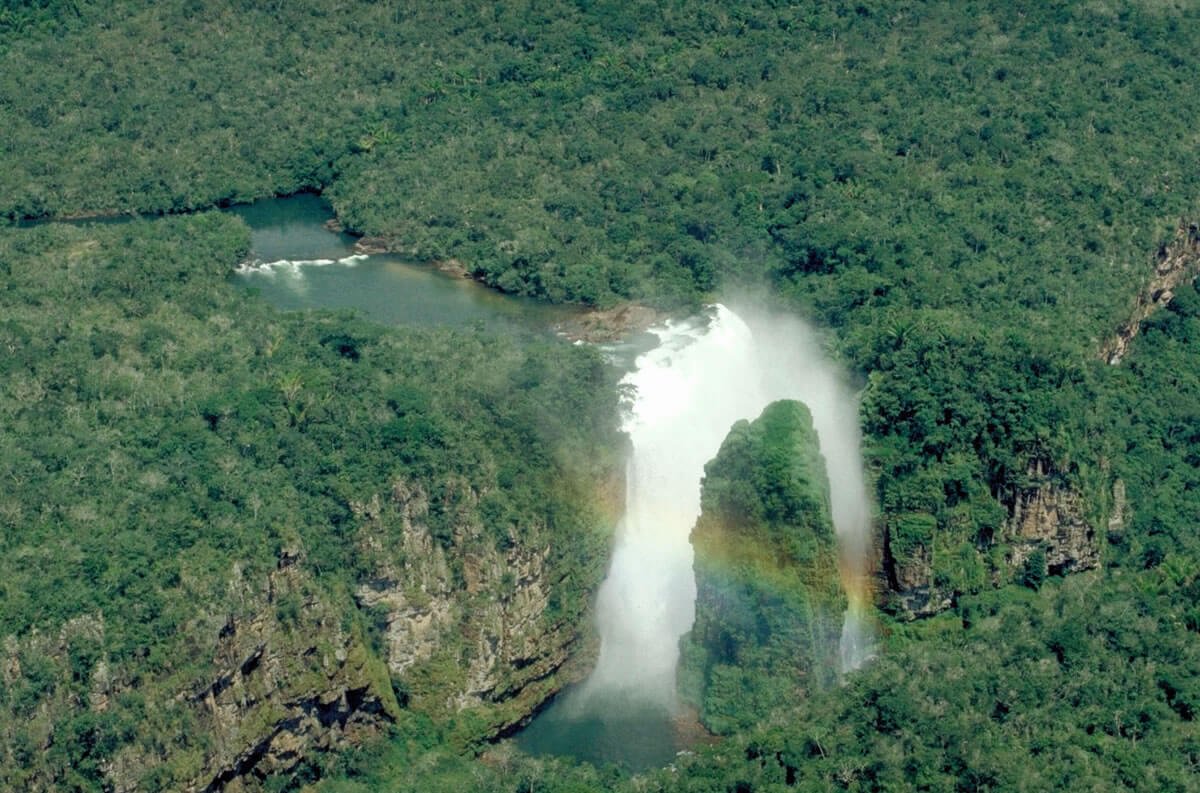
Noel Kempff Mercado National Park
Introduction
Far from Bolivia's famous high-altitude landscapes, where the Andes dominate the country's image, another Bolivia exists - vast, humid, remote and almost untouched. In the far northeastern corner of the country, near the Brazilian border, Noel Kempff Mercado National Park protects an immense wilderness of Amazon rainforest, savannah, wetlands, rivers, cliffs and waterfalls.
Covering about 1.52 million hectares, the park is one of the largest and most intact protected areas in the Amazon Basin. Its isolation has helped preserve an extraordinary mixture of ecosystems, while its spectacular Huanchaca Plateau rises dramatically above surrounding forests and savannahs. In 2000, UNESCO recognized Noel Kempff Mercado National Park as a World Heritage Site for both its exceptional biodiversity and the evolutionary importance of its ecosystems.
For travelers, this is not a conventional national park. There are no easy roads leading deep into the wilderness, no large tourist infrastructure and few crowds. Reaching its waterfalls, lagoons and forest camps can require charter flights, 4x4 journeys and boat travel. That difficulty is part of its character. Noel Kempff Mercado feels less like a destination built for tourism and more like a journey into one of South America's remaining great wild frontiers.
Geographical and Environmental Significance
Noel Kempff Mercado National Park lies in Bolivia's Santa Cruz Department, close to the Brazilian frontier. Its landscape occupies an important ecological transition between the humid Amazon rainforest, the seasonally dry Chiquitano forests and the cerrado savannahs. This meeting of ecosystems is one of the reasons the park supports such remarkable biological diversity.
The park ranges from roughly 200 metres to nearly 1,000 metres above sea level. At its heart is the Huanchaca, or Caparú, Plateau, an ancient geological formation associated with the Precambrian Shield. The rocks beneath the landscape record more than a billion years of geological history, giving the region significance far beyond its scenery.
This ancient foundation supports an unusually varied landscape. Evergreen Amazonian forests grow alongside palm forests, seasonally dry forests, wetlands, gallery forests, cerrado grasslands and savannahs. Rivers and black-water lagoons add another dimension, creating habitats for fish, reptiles, amphibians and aquatic birds.
The climate is distinctly seasonal. The region receives roughly 1,400 to 1,500 millimetres of rainfall annually, with most precipitation arriving during the warmer austral summer. The dry season is generally concentrated between June and September, while average annual temperatures remain around 25-26°C.
The biological numbers are remarkable. UNESCO estimates around 4,000 plant species and more than 600 bird species within the park, alongside viable populations of numerous globally threatened vertebrates. Other conservation assessments record hundreds of mammal, reptile, amphibian and fish species.
The park's ecological importance is also tied to its isolation. The cerrado habitats of the Huanchaca Plateau have remained separated from similar ecosystems for millions of years, creating what UNESCO describes as a natural laboratory for studying ecological evolution.
Landscapes or Heritage
The most dramatic landscape in Noel Kempff Mercado is the Huanchaca Plateau, a vast elevated sandstone landscape surrounded by dense vegetation. Its cliffs create some of the park's most spectacular scenery, with water plunging over the edges into forested valleys below.
Among the best-known waterfalls are Arcoiris Falls and El Encanto. Arcoiris Falls drops dramatically from the plateau, while El Encanto forms another spectacular cascade beneath the Caparú landscape. The waterfalls become particularly impressive when rivers and streams are swollen by seasonal rainfall.
The surrounding forests are equally important. Rather than forming one endless wall of identical rainforest, Noel Kempff Mercado contains a constantly changing mosaic. Dense evergreen forest gives way to open savannah, wetlands, palm-covered areas and seasonally flooded landscapes. This variety makes exploration visually rewarding and creates opportunities for wildlife observation.
Laguna Chaplin is another notable destination. Located in the southern part of the park, the lagoon can be explored by trails and boat, offering a quieter experience of the park's waterways and surrounding forest.
The rivers are fundamental to the landscape. The Iténez forms part of the park's northern and eastern boundary along Brazil, while the Paraguá drains the western side. These waterways are not simply scenic features - they are transportation routes, wildlife habitats and part of the ecological system that connects forests, wetlands and seasonal floodplains.
There is also a deeper human history around the park. Indigenous peoples have inhabited the wider region for generations, and communities around the park include Chiquitano populations. Nearby eastern Bolivia is also famous for the Jesuit Missions of Chiquitos, whose historic settlements provide an important cultural complement to the wilderness of Noel Kempff Mercado.
The park itself is named after Bolivian biologist Noel Kempff Mercado, who was killed in 1986. His name became associated with one of Bolivia's most important conservation landscapes, and the national park was later recognized internationally for its natural significance.
Culture
Although Noel Kempff Mercado is primarily known for wilderness and biodiversity, its surrounding communities are an important part of the destination's identity. The wider Bajo Paraguá region has strong Chiquitano cultural connections, and communities such as Piso Firme and Florida have traditionally maintained close relationships with rivers, forests and surrounding natural resources.
Life in this part of Bolivia is shaped by geography. Rivers are transportation corridors, forests provide food and materials, and seasonal changes influence travel and livelihoods. Visiting the park therefore offers a glimpse into a region where the landscape remains much more influential in daily life than in Bolivia's major cities.
The nearby Chiquitanía also provides an important cultural journey beyond the park. Towns such as San Ignacio de Velasco and Concepción are associated with Bolivia's Jesuit Mission heritage, creating a striking contrast between historic mission architecture and the deep wilderness farther north.
For travelers, the cultural experience is best approached through local guides and communities rather than simply treating the region as a wilderness backdrop. Local knowledge can reveal how rivers are navigated, how wildlife is observed and how people have adapted to one of Bolivia's most remote environments.
Cuisine
Food in the Noel Kempff Mercado region reflects the broader cuisine of eastern Bolivia, where tropical ingredients, river fish, rice, cassava, plantains and locally produced meats are common.
In communities around the park, meals are generally practical and closely connected to local availability. Fresh fish from regional rivers can form an important part of the diet, while yuca, rice and plantains are common staples. Grilled meats and hearty regional dishes are also characteristic of the Santa Cruz lowlands.
Travelers should not expect a sophisticated food scene inside the national park. Remote camps focus on simple meals suited to expeditions rather than restaurants or culinary tourism. The real food experience comes through the communities and towns used as gateways to the park.
Before or after an expedition, Santa Cruz de la Sierra offers a much broader introduction to eastern Bolivian cuisine. Regional specialties can include dishes such as majadito, a rice-based preparation with meat and plantain, along with grilled meats, empanadas and tropical fruits.
Sustainability
Conservation is central to Noel Kempff Mercado National Park because its immense size protects an extraordinary concentration of ecosystems. The park is managed within Bolivia's national protected-area system, and its World Heritage status reflects its global importance.
Current conservation work continues to focus on protecting biodiversity, improving protected-area management and strengthening cooperation between government agencies and conservation organizations. In 2026, Bolivia's SERNAP and Fundación Amigos de la Naturaleza announced a cooperation agreement that includes support for conservation of Noel Kempff Mercado, environmental monitoring, fire prevention and response, research and capacity building.
Wildlife conservation is particularly important. In June 2026, SERNAP announced the successful release of a rehabilitated jaguar named Yaguara into habitat within Noel Kempff Mercado following a two-year collaborative conservation effort involving several Bolivian institutions and organizations.
The park nevertheless faces broader pressures affecting tropical protected areas, including deforestation, fires, resource extraction and pressure on wildlife. Maintaining ecological connectivity and controlling damaging activities around the park remain important long-term conservation challenges.
Visitors have an important role to play. Because the park is exceptionally remote, travel should be organized through experienced operators and local guides. Travelers should stay on established routes, avoid disturbing wildlife, carry waste out of sensitive areas and respect restrictions designed to protect forests, rivers and archaeological or cultural sites.
Best Time to Visit
The best time to visit Noel Kempff Mercado National Park depends on what kind of experience you want, but the dry season is generally the most practical period for exploration.
From roughly June to September, rainfall decreases significantly and many trails and access routes become easier to navigate. The lower rainfall can also make overland travel more manageable, although cold southern air incursions can occasionally bring surprisingly cool conditions to the tropical lowlands.
The rainy season, generally extending from October into April, transforms the landscape. Forests become intensely green, rivers rise and waterfalls can become more powerful. However, heavy rainfall can make roads and trails difficult and may complicate river or air access.
For photographers and travelers particularly interested in waterfalls and lush tropical scenery, the wetter months can offer spectacular conditions if access is operating normally. For trekking, wildlife observation and more reliable transportation, the drier months are usually easier.
Because access is complicated and conditions can vary substantially, visitors should confirm transportation, park access and local conditions before departure rather than relying solely on a fixed seasonal itinerary.
Transport
Getting to Noel Kempff Mercado National Park is an adventure in itself. The park's remoteness has helped preserve its ecosystems, but it also means that this is not a destination that can be reached by a simple public bus or conventional road trip.
Most journeys begin in Santa Cruz de la Sierra. From there, travelers can reach different sectors of the park using a combination of charter aircraft, 4x4 vehicles and boats. The Los Fierros sector in the south is one of the principal access points and can be reached by small aircraft from Santa Cruz. Other routes involve traveling overland toward communities such as Florida or Piso Firme before continuing by river.
Flor de Oro, on the Iténez River near the Brazilian border, is another important park sector. River-based journeys can provide an especially immersive introduction to the landscape, although they are dependent on water levels and seasonal conditions.
Within the park, transportation is largely by boat, on foot and, where available, small aircraft. There is no conventional network of tourist roads connecting the major attractions. This means that an organized expedition with local guides is usually the most practical approach.
Travelers should plan well in advance because flights, boats, permits, guides and accommodation in remote camps can be limited. The journey should be considered part of the experience rather than an inconvenience.
Why Visit
Noel Kempff Mercado National Park is one of the rare destinations where remoteness remains one of its greatest attractions.
It offers an extraordinary combination of Amazon rainforest, ancient geological formations, open cerrado, wetlands, black-water rivers and towering waterfalls within a single protected landscape. UNESCO's recognition confirms that this is not simply a beautiful wilderness but an ecosystem of global scientific and conservation importance.
The park is especially compelling for travelers who want to experience a less-developed side of the Amazon. Instead of large lodges, crowded viewpoints and heavily visited trails, Noel Kempff Mercado offers long river journeys, remote camps, forest trails and enormous landscapes where the scale of the wilderness is often more impressive than the number of visitors.
Its Huanchaca Plateau provides the visual drama, its forests provide the mystery, its rivers provide the routes through the wilderness, and its biodiversity provides the reason for protecting the entire landscape.
Perhaps most importantly, Noel Kempff Mercado demonstrates that Bolivia's natural identity extends far beyond the Andes. The country is home not only to high mountains and salt flats but also to one of the great surviving wilderness landscapes of the Amazon Basin.
Conclusion
Noel Kempff Mercado National Park is Bolivia's lost jungle in the truest sense - remote, immense and remarkably rich in life. From the ancient cliffs of the Huanchaca Plateau to the forests, lagoons, rivers and waterfalls surrounding them, the park presents a side of Bolivia that few international travelers ever encounter.
Its extraordinary mixture of Amazonian rainforest, cerrado, wetlands and dry forest has earned global recognition, while its isolation has helped protect landscapes that have evolved over immense stretches of geological and ecological time.
Traveling here requires patience, planning and a willingness to leave conventional tourism behind. But for those prepared to make the journey, Noel Kempff Mercado offers something increasingly rare: the feeling of entering a genuinely wild landscape where nature remains the dominant presence.
In a country famous for spectacular extremes, this hidden Amazonian wilderness stands as one of Bolivia's most remarkable natural treasures.
00 Comments
No comments yet.
Leave a Comment