

Loango National Park
Introduction
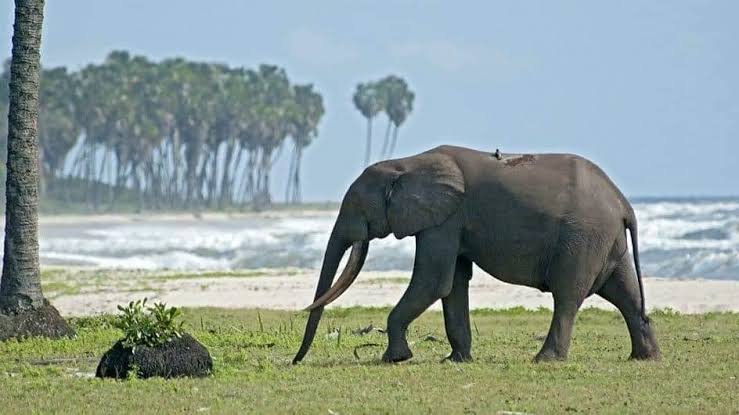
Along Gabon's southwestern Atlantic coast lies a wilderness so unusual that its defining image almost sounds impossible: forest elephants emerging from dense rainforest and walking across an empty ocean beach, while hippopotamuses enter the Atlantic surf and humpback whales pass offshore.
This is Loango National Park, one of Africa's most extraordinary coastal wildernesses. Covering approximately 155,000 hectares, the park combines rainforest, savannah, lagoons, mangroves, wetlands and long stretches of pristine Atlantic coastline. It forms part of the larger Gamba protected-area landscape in southwestern Gabon, a region internationally recognized for its exceptional biodiversity.
Loango is particularly famous for bringing together wildlife normally associated with very different environments. Forest elephants, buffaloes, gorillas, hippos and leopards inhabit landscapes that reach directly to the sea, while leatherback turtles nest on the beaches and whales and dolphins can be observed offshore.
For travelers looking for an African destination far beyond the conventional safari circuit, Loango offers something remarkably rare. Here, the boundary between jungle and ocean almost disappears.
Geographical and Environmental Significance
Loango National Park is situated in Gabon's Ogooué-Maritime and Nyanga provinces, roughly 300 kilometres south of Libreville. Its geography is shaped by the meeting of the Atlantic Ocean with the low-lying coastal plains of Gabon.
The park contains an extraordinary mosaic of habitats. Dense tropical forests transition into coastal savannahs, lagoons, marshes, mangroves and sandy beaches. Long parallel coastal sand ridges separate freshwater and brackish lagoons from the Atlantic, creating a complex wetland system that stretches for many kilometres.
One of the most important water bodies is the Iguéla Lagoon, a large lagoon system connected to surrounding wetlands and forests. Its mixture of saltwater, brackish water and freshwater creates different ecological niches for fish, reptiles, birds and mammals. The lagoon and surrounding flooded forests are particularly important habitats for elephants, buffaloes, hippos, manatees and other wildlife.
The coastal environment is equally significant. Loango's beaches provide nesting habitat for leatherback turtles and are part of one of the world's most important leatherback nesting regions. UNESCO's World Heritage tentative-list documentation describes the beaches as supporting an average of around 30,000 leatherback nests annually.
The park also belongs to the wider Gamba-Mayumba-Conkouati ecological landscape, a major protected-area complex along the Atlantic coast of Gabon and neighboring Central Africa. This larger landscape connects forests, wetlands, coastal habitats and marine environments that together support remarkable biological diversity.
Landscapes or Heritage
The defining landscape of Loango is its extraordinary coastline. Long, empty beaches stretch beside tropical vegetation, creating a dramatic contrast between golden sand and dense green forest.
In many African parks, wildlife viewing takes place on savannahs or along forest tracks. Loango changes the equation. Forest elephants can appear on the shoreline, sometimes moving between coastal vegetation and freshwater areas. Buffaloes may graze near the beach, while hippopotamuses can venture into the ocean. UNESCO identifies Loango as one of the rare places where visitors may encounter large mammals such as elephants, buffaloes and hippos directly on the Atlantic coast.
The sight of a hippopotamus entering the surf is particularly distinctive. These animals are normally associated with African rivers and lakes, yet Loango's coastal ecology allows them to move between lagoons, wetlands and the ocean.
Beyond the beaches, the park's interior contains dense lowland rainforest, swamp forest and open savannah. These habitats support western lowland gorillas, several species of monkeys, forest antelopes, warthogs, reptiles and numerous bird species. Leopards also occur in the park, although sightings are naturally far less predictable than those of more conspicuous animals.
The lagoons provide another way to experience the landscape. Boat journeys can reveal a completely different side of Loango, with crocodiles, fish, aquatic birds and hippos appearing around the waterways while forest rises along the banks.
Offshore, the Atlantic adds another layer to the wilderness. Humpback whales and dolphins can be observed from the coast during the appropriate season, particularly from June to September according to UNESCO's description of the park.
Loango also has an important human history. Places such as Petit Loango and Sette Cama contain evidence of historical settlement and trade, while the wider coastline was connected to the former Kingdom of Loango and precolonial commercial networks.
Culture
Loango's cultural identity is inseparable from the communities that have lived around its forests, rivers and coast for generations. Fishing, forest resources and movement along waterways have historically shaped life in the region.
The village of Sette Cama, located near the park, is particularly associated with the cultural landscape of southern Gabon. Traditional knowledge of the coast and lagoons can provide visitors with a deeper understanding of the environment than wildlife viewing alone.
The region also preserves traces of older trading networks. UNESCO notes that Petit Loango and Sette Cama were sites connected to precolonial commercial exchanges, linking the coastal communities of present-day Gabon with wider Atlantic Central Africa.
Local crafts, fishing traditions and community-based tourism can form part of a visit, particularly when travelers use local guides. This approach makes the journey about more than spotting animals. It places the park within the human history of Gabon's Atlantic coast.
Loango's culture is therefore best understood not as something separate from the wilderness, but as part of a long relationship between people, rivers, forests and the sea.
Cuisine
Cuisine around Loango reflects the food traditions of coastal Gabon, where freshwater and marine resources combine with tropical forest and agricultural ingredients.
Fresh fish is naturally important in coastal communities, with grilled and stewed preparations commonly appearing alongside staples such as cassava, plantains and rice. Seafood can include prawns, crabs and other locally available marine species, while river and lagoon fish provide another source of protein.
Gabonese cuisine also includes dishes built around peanuts, leafy vegetables, cassava and aromatic sauces. In villages around the park, meals are generally simple, fresh and closely connected to local availability rather than designed for international tourism.
Travelers should expect food in remote Loango camps and lodges to be practical rather than elaborate. Meals are often part of the expedition experience, eaten after long days spent on beaches, lagoons or forest trails.
For a broader introduction to Gabonese food, Libreville offers a much wider selection of restaurants and markets before or after a journey into the country's remote southwest.
Sustainability
Loango's extraordinary biodiversity makes conservation essential. The park was formally established as part of Gabon's national-park system in 2002, and its ecological importance has also led to its inclusion on UNESCO's Tentative List for potential World Heritage recognition.
The park is also part of a Ramsar-recognized wetland complex, strengthening protection for its coastal and lagoon ecosystems.
Marine turtle conservation is particularly important. Leatherback turtles come ashore to nest along the beaches, making protection of nesting areas and careful management of nighttime beach activities essential. Earlier conservation initiatives in the wider Gamba complex have included marine-turtle monitoring, research and protection programmes.
The wider ecosystem faces pressures from activities outside the protected area, including industrial fishing and oil development. UNESCO's assessment specifically identifies surrounding economic activities as potential pressures on the park's long-term integrity.
Responsible tourism therefore matters. Visitors should follow guide instructions around elephants, hippos and gorillas, maintain appropriate distances from wildlife, avoid disturbing nesting turtles and never leave waste behind. Boat operators and guides should also follow practices that minimize disturbance to marine mammals.
The strongest form of sustainable tourism in Loango is one that supports local employment and conservation while allowing the ecosystem itself to remain the main attraction.
Best Time to Visit
Loango can be visited at different times of the year, but the best period depends on the wildlife and landscapes a traveler hopes to experience.
The drier season generally provides more comfortable conditions for exploring beaches, savannahs and forest trails, while the wetter periods can produce greener landscapes and fuller lagoons. Because tropical rainfall varies from year to year, conditions can change quickly.
Marine wildlife adds a seasonal dimension. Humpback whales and dolphins can be observed offshore, with UNESCO identifying June through September as a particularly notable period for whale and dolphin sightings.
Leatherback turtle nesting provides another important seasonal attraction. Nesting activity takes place during the broader nesting season on Gabon's Atlantic beaches, but exact timing and beach access can vary, making local conservation guidance essential.
For travelers primarily interested in elephants and other terrestrial wildlife, seasonal movements around beaches, lagoons and forest clearings mean that sightings can never be guaranteed. This unpredictability is part of the appeal of a genuine wilderness destination.
Transport
Reaching Loango National Park requires more planning than visiting many of Africa's better-known safari destinations.
Most international journeys begin in Libreville, Gabon's capital. From there, travelers generally continue toward the southwestern protected-area complex by a combination of domestic transportation, road travel, boats or chartered flights, depending on the chosen camp and entrance point.
Port-Gentil can also serve as an important gateway for some itineraries. From the coastal towns and park access points, boats and 4x4 vehicles are commonly used to reach remote areas.
The precise route depends heavily on where accommodation is located. Loango is a large wilderness rather than a single attraction with one central entrance, so transportation should normally be arranged as part of an organized safari or specialist expedition.
This remoteness is one of the reasons Loango has retained its wild character. There are no major highways cutting across the park and no conventional tourist infrastructure comparable to the famous safari parks of East Africa.
Travelers should therefore allow extra time for transfers and remain flexible about weather and road or river conditions.
Why Visit
Loango National Park offers one of Africa's most unusual wildlife experiences because it brings together two worlds that are rarely seen in such close proximity.
Here, the rainforest does not end where the beach begins. Elephants can cross the sand, buffaloes can graze near the coastline and hippos can move through coastal waters. Offshore, whales pass through the Atlantic while leatherback turtles return to the same beaches where terrestrial wildlife roams.
The park is also exceptionally diverse. Rainforest, savannah, mangrove, freshwater lagoons, marshes and Atlantic beaches exist within one protected landscape. This ecological variety explains why Loango supports such a remarkable range of mammals, birds, reptiles, fish and marine species.
For photographers, the possibilities are extraordinary: an elephant against an empty Atlantic beach, a hippo surrounded by surf, a forest emerging behind a lagoon or a whale appearing beyond the breakers.
But Loango's greatest attraction may simply be its sense of wilderness. The landscapes are expansive, the visitor numbers are relatively low and wildlife encounters remain unpredictable. Instead of moving through a carefully choreographed safari environment, travelers enter an ecosystem where the animals determine the experience.
Conclusion
Loango National Park is one of the world's most extraordinary places to experience the meeting of rainforest and ocean. Its beaches are not merely scenic stretches of sand - they are wildlife habitat, turtle nesting grounds and corridors used by some of Central Africa's most iconic animals.
The image of elephants walking along an Atlantic beach captures the park's uniqueness, but Loango is far more than a remarkable photograph. Its lagoons, wetlands, mangroves, forests, savannahs and marine habitats form an interconnected ecosystem of international conservation importance.
For travelers willing to venture beyond the established safari routes, Loango offers a rare combination of solitude, biodiversity and extraordinary wildlife encounters. It is a place where the boundaries between jungle, wetland and sea become blurred - and where Africa's wildlife can appear in landscapes few people expect to find them.
Loango is, quite simply, where the rainforest meets the Atlantic and elephants walk the beach.
00 Comments
No comments yet.
Leave a Comment