

Khao Sok National Park
Introduction
Hidden in the lush interior of southern Thailand, far from the country's famous beaches and island resorts, Khao Sok National Park is a world of towering limestone cliffs, ancient rainforest, emerald lakes, mist-covered mountains, and remarkable wildlife. Located in Surat Thani Province, the park is one of Thailand's most spectacular natural destinations and forms part of one of the largest remaining rainforest landscapes in southern Thailand.
Khao Sok is often described as one of the world's oldest rainforests, and its extraordinary landscape gives the description a sense of scale. Towering karst formations rise dramatically above dense jungle, while rivers and streams wind through valleys beneath enormous trees. In the northern part of the park, the vast waters of the Rajjaprabha Reservoir, commonly known as Cheow Lan Lake, create an almost surreal landscape of emerald water and limestone peaks. Thailand's tourism authority describes the park as covering about 738.74 square kilometers and highlights its diverse rainforest ecosystems and rare wildlife.
Unlike Thailand's coastal destinations, Khao Sok is defined by wilderness rather than beaches. Its attractions are found along jungle trails, hidden waterways, caves, cliffs, waterfalls, and floating camps surrounded by mountains.
The park is also one of the country's most important wildlife areas. Marbled cats, Malayan tapirs, serows, rare birds, and the spectacular Rafflesia flower are among the natural treasures associated with Khao Sok.
For travelers looking for unique places to visit in Thailand, Khao Sok offers an extraordinary opportunity to experience a side of the country that feels ancient, remote, and deeply connected to the natural world.
Geographical and Environmental Significance
Khao Sok National Park lies in Surat Thani Province in southern Thailand and occupies a strategic position between the Gulf of Thailand and the Andaman coast. Its forests form part of a larger protected landscape that is important for maintaining biodiversity and water resources in the region.
The park covers approximately 738.74 square kilometers, including extensive areas north of the Rajjaprabha Dam. Its geography is dominated by limestone mountains, forested hills, valleys, rivers, marshlands, and karst formations. The Tapi River has its origins in the wider forest landscape around Khao Sok.
The limestone formations are among the park's most recognizable geographical features. Over geological time, erosion has carved the limestone into steep towers and ridges, creating the dramatic scenery that surrounds Cheow Lan Lake.
Rainfall is another defining force. Southern Thailand experiences strong monsoon influences, and Khao Sok's humid tropical climate supports dense evergreen forest. The result is a landscape that remains intensely green for much of the year.
This rainforest provides habitat for an impressive range of wildlife. Thailand's tourism authority identifies species such as the marbled cat, Malayan tapir, Fea's muntjac, serow, and rare birds including the hooded pitta and Malayan banded pitta.
Khao Sok is also famous for unusual plant life. The park contains rare palms and, most famously, species of Rafflesia - enormous parasitic flowers that can reach around 70 to 80 centimeters across. These flowers are remarkable not only for their size but also because their blooming period is extremely short. Tourism Thailand notes that Rafflesia flowers may bloom for only four to five days after taking around nine months to develop.
The combination of ancient rainforest, limestone geology, abundant rainfall, rivers, and rare species makes Khao Sok one of southern Thailand's most environmentally important landscapes.
Landscapes or Heritage
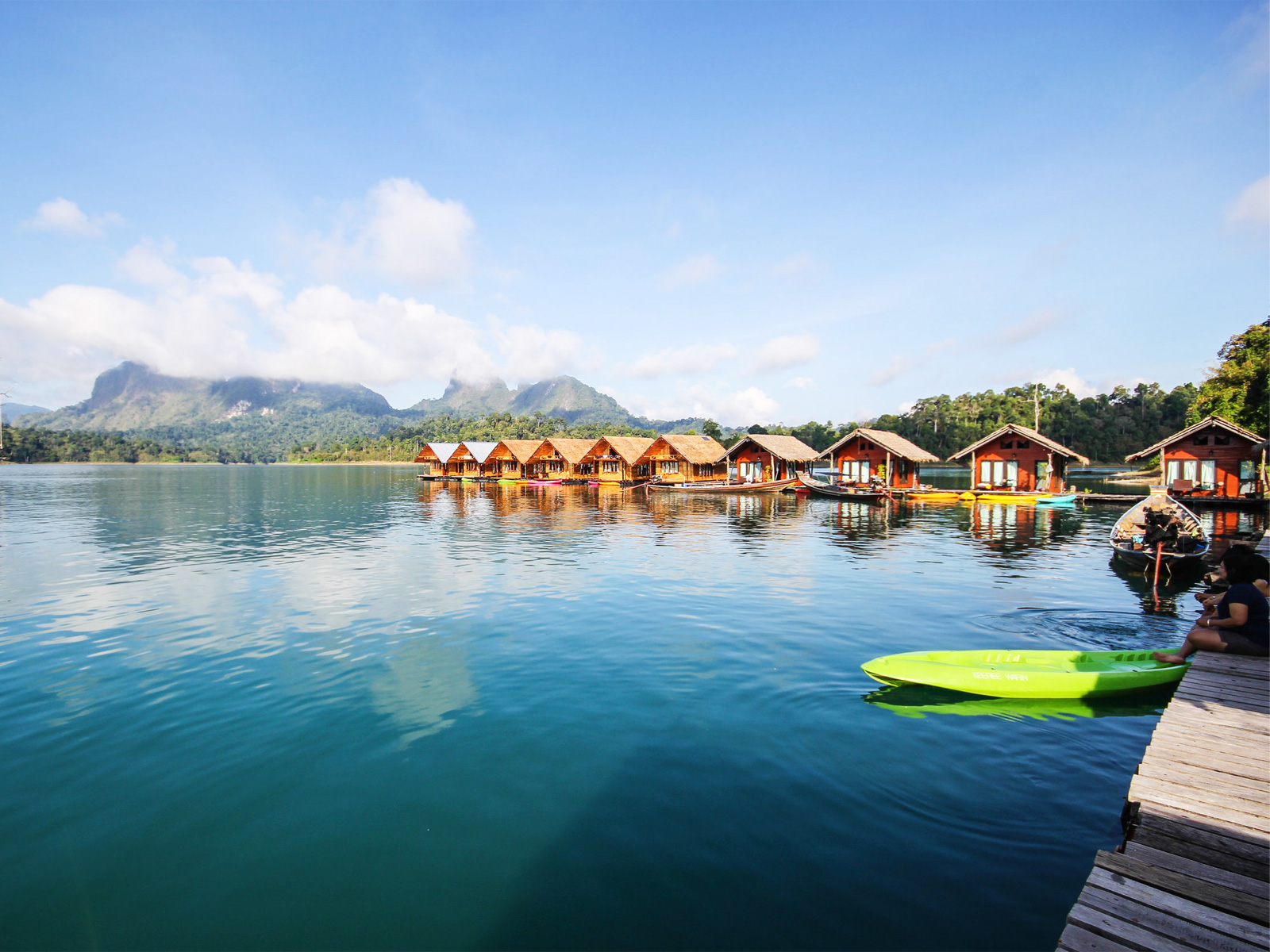
The most iconic landscape of Khao Sok is undoubtedly Cheow Lan Lake. Created by the Rajjaprabha Dam, the reservoir transformed the valleys north of the dam into an immense network of waterways surrounded by steep limestone mountains.
Today, the lake is one of Thailand's most extraordinary inland landscapes. Tall karst peaks emerge from emerald-colored water, often surrounded by mist in the early morning. Thailand's tourism authority compares the scenery around the reservoir to "Thailand's Guilin" because of its distinctive limestone formations and dramatic waterscape.
One of the most recognizable formations is Khao Sam Kler, often called the Three Friends. Three limestone pinnacles rise from the water close together, creating one of the most photographed landscapes in Khao Sok.
Exploring the lake by long-tail boat is one of the best ways to understand its scale. The boat moves between narrow waterways and towering cliffs, revealing small islands, forest-covered slopes, and secluded inlets.
Floating raft houses provide another distinctive experience. Instead of staying in a conventional hotel, visitors can spend the night on the lake surrounded by mountains and water. Kayaking is also popular, allowing travelers to explore smaller areas at a slower pace.
The national park's rainforest offers an entirely different landscape. Jungle trails lead through dense vegetation toward waterfalls, caves, viewpoints, and streams. Trekking can range from relatively accessible walks to longer excursions requiring local guides and greater preparation.
Caves are another part of Khao Sok's geological heritage. Pakarang Cave, also known as Coral Cave, contains limestone formations shaped by erosion, including stalactites and stalagmites. Tourism Thailand notes that fossils discovered in the area have been dated to between approximately 250 and 400 million years ago.
Together, the rainforest and lake create a rare combination - an ancient tropical forest landscape intertwined with a modern reservoir and dramatic limestone geology.
Culture
Although Khao Sok is primarily known for nature, the surrounding communities are an important part of the destination's identity.
Villages around the park have traditionally depended on agriculture, forestry-related livelihoods, fishing, and the natural resources of southern Thailand. As tourism developed, local communities increasingly became involved in guiding, accommodation, transportation, food services, and nature-based activities.
The park's location between the Gulf of Thailand and Andaman coast also gives the region an interesting geographical role. Travelers can use Khao Sok as an inland connection between two of southern Thailand's major coastal areas.
Traditional knowledge remains especially important when exploring the rainforest. Local guides understand trails, plants, weather conditions, waterways, and wildlife behavior in ways that are difficult to replicate through independent exploration.
The development of community tourism has also created opportunities for visitors to experience local life more directly. Thailand's recent green tourism initiatives highlight community tourism and low-carbon practices in Khao Sok as part of efforts to encourage more responsible travel.
Rather than treating the rainforest simply as an adventure playground, responsible tourism allows visitors to understand how local communities and protected landscapes can exist alongside one another.
Cuisine
Khao Sok's cuisine reflects the broader food culture of southern Thailand, one of the country's most distinctive culinary regions.
Southern Thai food is famous for bold flavors, aromatic herbs, seafood, chilies, coconut, turmeric, and rich curry pastes. Meals often have a stronger and spicier character than food found in some other parts of Thailand.
Visitors staying near the park or around Cheow Lan Lake can encounter dishes based on fresh vegetables, fish, chicken, pork, and locally available ingredients.
Gaeng Som, a sour and spicy curry popular throughout southern Thailand, is one regional specialty worth trying. It is commonly prepared with fish or other ingredients and has a distinctive balance of sourness and heat.
Fresh fish is naturally important around the lake, while rice remains the foundation of many local meals. Simple stir-fries, soups, curries, grilled dishes, and spicy salads are common throughout the region.
Travelers staying in floating accommodations may encounter relatively simple menus designed around the practical conditions of life on the reservoir. These meals can become part of the experience, particularly when eaten on a floating raft while surrounded by limestone mountains.
For visitors accustomed to Thailand's major tourist centers, Khao Sok provides an opportunity to experience southern flavors in a setting much closer to rural communities and the natural environment.
Sustainability
Khao Sok's greatest attraction is its natural environment, which makes sustainability essential to the future of tourism in the park.
The rainforest provides habitat for rare wildlife and plants while also supporting important watersheds. Protecting the forest therefore benefits biodiversity as well as surrounding communities.
Tourism Thailand's current green tourism material specifically presents Khao Sok as a destination emphasizing slow travel, low-impact experiences, community tourism, and low-carbon practices.
Visitors can contribute to conservation by staying on established trails, avoiding litter, reducing single-use plastics, respecting wildlife, and following national park regulations.
Wildlife should never be fed or deliberately disturbed. Animals such as Malayan tapirs, birds, and smaller forest species are best observed quietly and from a respectful distance.
The same principle applies to plants. Rare species such as Rafflesia are extremely vulnerable to disturbance, and visitors should never pick flowers or damage surrounding vegetation.
Choosing locally operated guides, restaurants, homestays, and other services can also help ensure that tourism benefits communities surrounding the park.
The floating accommodation experience on Cheow Lan Lake should likewise be approached responsibly. Travelers can conserve water and electricity, avoid throwing waste into the lake, and choose operators that demonstrate responsible environmental practices.
Khao Sok is most valuable when experienced as a living ecosystem rather than simply a collection of attractions. Protecting that ecosystem is what allows future generations to experience the same rainforest, mountains, and waterways.
Best Time to Visit
Khao Sok can be visited throughout much of the year, but weather has a significant influence on the experience.
The park receives substantial rainfall because of its tropical climate and monsoon patterns. Thailand's tourism authority describes the country's climate as being influenced by both summer and winter monsoons, with distinct rainy, cooler, and hotter periods.
For travelers seeking more predictable conditions for trekking and lake excursions, the drier period is generally more comfortable. However, the rainy season has its own advantages.
During wetter months, the rainforest becomes exceptionally lush, waterfalls become more powerful, and mist frequently settles around the limestone peaks. Tourism Thailand specifically highlights Cheow Lan Lake during the rainy season, when mist drifts across the emerald water and mountains, creating an especially atmospheric landscape.
Wildlife enthusiasts may appreciate the quieter atmosphere of the wet season, although trails can become muddy and boat excursions may be affected by weather.
The best time ultimately depends on your priorities. Choose drier months for easier trekking and more predictable outdoor conditions, or visit during the rainy season if you want Khao Sok at its greenest and most atmospheric.
For photography, early mornings are particularly rewarding. Mist rising from the lake around the limestone peaks can create spectacular scenes before the sun becomes stronger.
Transport
Khao Sok National Park is located in Surat Thani Province and can be reached from several major travel hubs in southern Thailand.
The nearest major airports include Surat Thani, Phuket, and Krabi, making Khao Sok relatively convenient to combine with other destinations in southern Thailand.
From Surat Thani, travelers can continue by bus, minivan, private transfer, or taxi toward Khao Sok. The journey typically passes through rural landscapes before reaching the forested hills around the park.
From Phuket or Krabi, road transfers provide another option, particularly for travelers combining Khao Sok with Thailand's Andaman coast.
Khao Sok itself has two major areas that visitors should understand: the village and park headquarters area around Khlong Sok, and the Cheow Lan Lake area around Rajjaprabha Dam. They are separated by a significant road journey, so travelers should plan accommodation and activities accordingly.
Boat transportation becomes essential once exploring Cheow Lan Lake. Long-tail boats take visitors between the pier, limestone formations, caves, viewpoints, and floating accommodations. Thailand's tourism authority highlights sightseeing by boat, overnight raft stays, kayaking, and wildlife observation as major experiences on the reservoir.
Within the rainforest, walking trails and guided treks are the primary ways to explore. For longer or more remote routes, using a knowledgeable local guide is strongly recommended.
Why Visit
Khao Sok National Park is one of Thailand's most rewarding destinations for travelers who want to experience the country beyond its beaches.
Its greatest strength is the extraordinary variety contained within one protected landscape. You can trek through ancient rainforest in the morning, travel by long-tail boat between limestone cliffs in the afternoon, and spend the night on a floating raft surrounded by mountains.
For wildlife enthusiasts, the park offers the possibility of encountering species that are rarely seen elsewhere in Thailand, including Malayan tapirs, serows, rare birds, and unusual plants such as Rafflesia.
For photographers, few places in Thailand offer a more dramatic combination of mist, water, rainforest, and limestone. The changing light over Cheow Lan Lake can completely transform the landscape within minutes.
Adventure travelers can explore jungle trails, caves, rivers, and waterways, while those seeking relaxation can simply stay on a floating raft and watch clouds drift across the mountains.
Khao Sok is also ideal for travelers who want a more immersive experience. Instead of moving quickly between tourist attractions, the park encourages a slower rhythm - walking through forests, listening to birds, watching the lake at sunrise, and experiencing the landscape without constantly rushing to the next destination.
Above all, Khao Sok feels different from the Thailand most visitors imagine. It replaces beaches and busy resort towns with rainforest, silence, limestone mountains, and wilderness.
Conclusion
Khao Sok National Park is a destination where Thailand's ancient rainforest landscape reaches extraordinary levels of beauty. Its dense jungle, towering limestone formations, rare wildlife, caves, waterfalls, and emerald waters create a world that feels far removed from the country's famous coastal resorts.
The landscape around Cheow Lan Lake is particularly unforgettable. Limestone peaks rising from the reservoir, mist moving across the water, and floating accommodations hidden among the mountains create one of southern Thailand's most distinctive travel experiences.
Yet the real value of Khao Sok lies beneath the scenery. The rainforest supports rare plants and animals, protects important watersheds, and provides a foundation for surrounding communities. Tourism therefore has an important responsibility to protect the very environment that makes the destination special.
For travelers searching for unique places to visit in Thailand, Khao Sok offers something increasingly rare - the opportunity to slow down and experience a genuinely immersive rainforest landscape.
Here, the journey is not simply about seeing another beautiful destination. It is about entering a world of ancient forest, emerald water, towering mountains, and living wilderness.
00 Comments
No comments yet.
Leave a Comment