

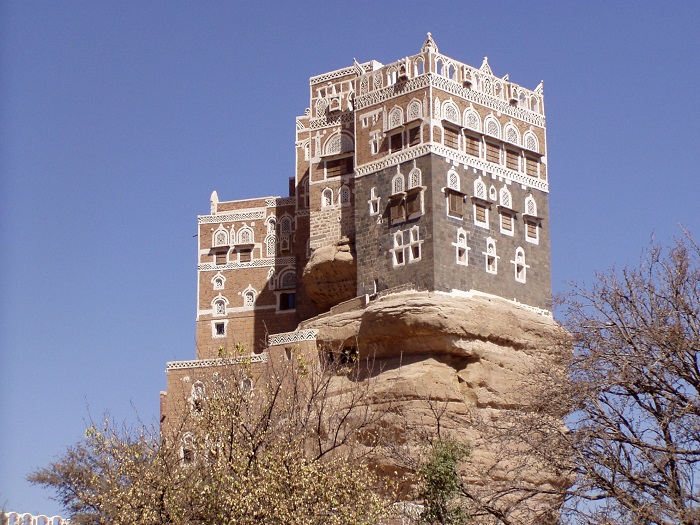
Dar Al-Hajar
Dar al-Hajar, also known as the Rock Palace, is one of Yemen's most iconic landmarks. Located in the Wadi Dhar valley outside the capital city of Sana'a, this stunning structure perched on a rock formation has captured the imagination of visitors for centuries. Its unique architecture, intriguing history, and breathtaking natural surroundings make it a must-visit destination for anyone interested in exploring Yemen's rich cultural heritage.
In this article, we will take a closer look at the history, significance, and beauty of this remarkable structure of Dar al-Hajar in Yemen.
What Is The Stone House In Yemen?
Dar al-Hajar, also known as the Stone House or Rock Palace, is a palace located in the Wadi Dhar valley outside of Sana'a, Yemen's capital city. It was built in the 1930s by Yahya Muhammad Hamid ed-Din, the ruler of Yemen at the time, as a summer retreat for his family.
The palace is famous for its unique location, perched atop a towering rock formation that gives it the appearance of a castle rising from the surrounding landscape. The name "Dar al-Hajar" means "House of Stone" in Arabic, a fitting name for a palace built entirely of local stone and featuring intricate stonework throughout its design.
Dar al-Hajar has great historical significance as Imam Yahya used it as a summer retreat and a venue for diplomatic meetings with foreign delegations. The palace was also briefly occupied by the British during the 1960s and later served as a museum and a presidential residence.
Apart from its historical significance, Dar al-Hajar is also admired for its remarkable beauty and unique location. The palace's impressive structure is built on a towering rock that resembles a natural pyramid, and the panoramic view from the palace offers a stunning vista of the Wadi Dhahr valley. The intricate carvings, delicate ornamentation, and beautiful archways add to the palace's beauty and charm, making it a true masterpiece of Yemeni architecture.
How Old Is Dar Al-Hajar?
Yahya Muhammad Hamid ed-Din, the former ruler of Yemen, constructed Dar al-Hajar, also known as the Stone House, in the 1930s. It is a relatively modern architecture. The palace was constructed on the site of an older fortress, which is said to have been built in the 18th century. The fortress was abandoned for many years before being transformed into a palace by Yahya Muhammad Hamid ed-Din, who was renowned for his love of art and architecture.
The palace served as a summer retreat for the royal family until the 1960s, after which it was opened to the public as a museum. Today, it remains one of Yemen's most iconic landmarks, attracting visitors from around the world with its unique architecture and stunning location.
Facts About Dar Al-Hajar
Here are some interesting facts about Stone House or Dar Al-Hajr in Yemen:
· Dar al-Hajar is a palace located outside of Sana'a, Yemen, built in the 1930s by the ruler of Yemen at the time.
· It is perched on a towering rock formation and offers breathtaking views of the surrounding Wadi Dhar valley.
· Visitors can climb the stone steps to reach the palace entrance, which is adorned with intricate carvings and designs.
· Inside, visitors can explore the various rooms and halls, which offer a mix of traditional Yemeni architecture and European styles.
· The central courtyard is a highlight, surrounded by rooms and featuring a fountain in the center.
· From the top of the palace, visitors can take in stunning views of the valley and the city of Sana'a.
· The unique architecture, stunning location, and intriguing history make it one of the country's most iconic landmarks.
· Dar al-Hajar is a testament to the rich cultural heritage of Yemen and a must-see for anyone visiting the country.
Exploring Dar Al-Hajar
Dar al-Hajar, which translates to "the stone house," was constructed on a towering rock formation that offers a stunning view of the valley below.
Visitors that visit Dar al-Hajar are taken back in time to see the beauty and grandeur of Yemen's past, making their exploration an unforgettable experience. The palace's striking architecture, deft carvings, and elaborate decorations highlight the nation's rich cultural legacy and its people's talent for handicrafts.
The palace was designed by a local architect named Kaid Omar, who incorporated elements of traditional Yemeni architecture, such as the use of mud bricks and intricate carvings, into the design. The palace was also influenced by the styles of Ottoman and Persian architecture, making it a unique fusion of different cultural traditions.
You can purchase a ticket to enter the palace. The five-story structure has a large number of rooms and numerous big and little steps that seem to lead in circles. There is a kitchen, storage space, female-only rooms, and meeting spaces for dignitaries and Imam Yahya's acquaintances. There are several places where you may go outside, a system for cooling water in earthenware jars, close-up views of takhrim windows, a quite deep well, and takhrim windows.
The five stories of the building provide enough to view. Its unique architecture, stunning location, and intriguing history make it one of the country's most iconic landmarks and a testament to the rich cultural heritage of Yemen. Walking around the building's foundation is similarly amazing and increases your enthusiasm for the wonderful architecture the Yemenis are capable of.
How To Get There?
Getting to Dar al-Hajar in Yemen involves some planning, as the country is currently experiencing political instability and security risks. Visitors should consult their government's travel advisories and take necessary safety precautions when planning their trip.
Assuming that travel to Yemen is feasible and safe, the easiest way to get to Dar al-Hajar is to hire a local guide or driver in Sana'a. The palace is located about 20 kilometers north of the city and can be reached by car or 4x4 vehicle.
It is important to note that the road leading to the palace can be challenging, as it is steep and winding, and requires a skilled driver. Visitors may also need to hike a short distance to reach the palace, as the road does not go all the way to the entrance.
Conclusion
Dar al-Hajar is a fascinating and unique destination showcasing Yemen's rich cultural heritage and architectural styles. Perched on a towering rock formation and offering stunning views of the surrounding valley, this palace is a must-see for anyone visiting the region. While traveling to Yemen can be challenging due to security risks and political instability, those who do make the journey can experience the beauty and history of this remarkable country.

00 Comments
No comments yet.
Leave a Comment